



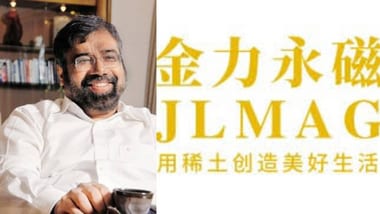
RPG Enterprises Chairman Harsh Goenka has drawn a comparison between China and India’s business priorities, pointing to the sectors he believes will shape the global economy over the next two decades and questioning what India is building for the future.
In a post on X on Tuesday, cited Chinese rare-earth magnet maker JL MAG as a “perfect example” of the country’s industrial strategy, highlighting its position in high-performance rare-earth magnets and its move into components for humanoid robots.
“China is building dominance in the industries that will define the next 20 years- rare earths, magnets, batteries, EVs, robotics, semiconductors and advanced manufacturing,” Goenka said.
He stated JL MAG’s approach reflects a broader strategy of controlling multiple stages of the industrial value chain.
“The strategy is simple: own the raw material, the technology, the manufacturing and eventually the entire ecosystem,” he said.
Goenka contrasted this with what he described as the focus of much of Indian business, saying companies were still pursuing consumer-facing opportunities such as bottled water, ice creams, snacks, packaged foods and instant delivery.
“Meanwhile, much of is still chasing softer opportunities- bottled water, ice creams, snacks, packaged foods and instant delivery,” he said.
He also commented on India’s software industry, saying its success has largely been driven by cost advantages rather than ownership of the underlying technology or infrastructure.
“Even our great software success is largely built on labour-cost arbitrage,” Goenka remarked.
Concluding his post, Goenka urged Indian businesses to consider which industries and technologies could become globally important in the years ahead.
“China is building tomorrow’s infrastructure. We, in India, should be asking- what are we building that the world will need tomorrow?” he said.
are vital to industrial robots and humanoid machines, where they are used in motors to deliver power, stability and the precision needed for joint movements. Their strategic importance grew amid geopolitical tensions last year after Beijing imposed export controls during its trade dispute with the US, disrupting global supplies and raising concerns about broader industrial disruptions.
JLMAG, founded in 2008, manufactures neodymium-iron-boron (NdFeB) permanent magnets, which are used across industries including electric vehicles, automotive components, wind power equipment, air conditioners, industrial motors and robotics. The company is listed on both the Shenzhen and Hong Kong stock exchanges.
It currently operates production facilities in Ganzhou, Baotou and Ningbo.
By the end of 2025, JLMAG had an annual production capacity of 40,000 tonnes and produced around 38,000 tonnes during the year, with its facilities running at more than 90% capacity.
The company is expanding its Baotou plant, adding another 20,000 tonnes of annual capacity. The expansion is expected to take JLMAG’s total production capacity to 60,000 tonnes by the end of 2027.
Beyond its existing applications, JLMAG is developing magnets and related products for emerging technologies, including motor rotors designed for humanoid robots. Its operations span magnet manufacturing, magnetic components, used-magnet recycling and other rare-earth-related activities.