



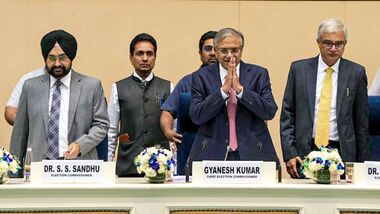
The opposition INDIA bloc on Monday kicked off its protest march towards the Election Commission of India (ECI) headquarters in the national capital
The protest is part of a broader “Save Democracy” campaign announced by the , under which its leaders have been holding demonstrations and public programmes against the EC.
Led by Leader of Opposition in the , the Opposition has stepped up its attack on Chief Election Commissioner Gyanesh Kumar over the controversial (SIR) of electoral rolls and changes to “Form 6”, used for voter registration.
The Opposition has alleged that the took unilateral decisions and accused it of facilitating systematic “vote theft” The march to Nirvachan Sadan is expected to further intensify the political confrontation between the Opposition and the poll panel over electoral roll-related issues.
Amid the row, LiveMint takes a look on the career, family, net worth and other details of Gyanesh Kumar.
The Chief Election Commissioner (CEC) of India draws a basic monthly salary of ₹2,50,000, equivalent to that of a judge or a . Previously, it was equivalent to the salary of a Supreme Court Judge.
The perks include:
•Monthly allowance of ₹34,000 (the CEC and Election Commissioners voluntarily resolved to give up income tax exemptions on this allowance).
• Entitled to LTC for self, spouse, and dependent family members (voluntarily curtailed from three times a year to one time a year).
• Free official government residence, official cars with chauffeurs, and security cover.
• Free or heavily subsidized electricity, water, telephone facilities, and comprehensive medical treatment/facilities for self and family.
•Substantial post-retirement pension and benefits aligned with high constitutional authorities.
Under the 1991 Act, which is now amanded, the salaries of CECs and ECs were equivalent to those of Supreme Court Judges. But the , equated the salaries of the CEC and ECs with those of the Cabinet Secretary.
Both salaries are currently equivalent but they are regulated differently. Article 125 of the Constitution requires that the salary of a be fixed by an Act of Parliament.
However, the salary of a Cabinet Secretary is fixed by the government upon the recommendation of the Central Pay Commission. Thus, the 2023 law allowed the Executive greater control over determining the salaries of the CEC and ECs.
is a 1988-batch IAS officer from the Kerala cadre. He became Election Commissioner in 2024 and the CEC in February 2025.
Kumar, 62, has worked with before. He retired as secretary in the Ministry of Cooperation, which comes under Amit Shah, on 31 January 2024. Before that, he also served as the secretary in the Ministry of Parliamentary Affairs.
Kumar was posted as Joint Secretary, Kashmir Division, in Amit Shah-led Home Ministry when was abrogated in August 2019.
In 2020, Kumar, posted as additional secretary, headed a in the Home Ministry to look after all matters related to the Supreme Court verdict on thecase, including the formation of the Shri Teerth Kshetra Trust.
Earlier, during the Congress-led UPA government, Kumar was posted as Joint Secretary (Defence Production) in the between 2007 and 2012.
Born on 27 January 1964 in Uttar Pradesh, Kumar is an engineering graduate of the , Kanpur, where he earned a BTech in Civil Engineering. He has also completed a PG in Economics from Harvard, USA, and is studying for the CFA at the Institute of Chartered Financial Analysts of India (ICFAI).
Kumar’s father was a doctor, and his grandfather was a freedom fighter and later a principal in Agra, Uttar Pradesh.
Kumar’s elder daughter Medha Roopam is a 2014-batch IAS officer who has served as District Magistrate (DM) of (Noida).
Medha’s Husband, Manish Bansal is a 2014-batch IAS officer who has served as District Magistrate of Agra.
Kumar’s younger daughter, Abhishri is an IRS officer (Income Tax) and an alumna of , Delhi. Her husband Akshay Labroo is a 2017-batch IAS officer who is currently posted as deputy commissioner of Srinagar in Jammu and Kashmir.
There is no public information available on CEC Gyanesh Kumar’s net worth.
In April this year, former TMC MP Saket Gokhale had questioned why the assets held by Gyanesh Kumar were declared “private information” under RTI. Gokhale said that as an IAS officer in the past, Kumar’s assets were supposed to be publicly available.
In a detailed post on X, Gokhale shared his RTI application and the response from the central government’s Department of Personnel and Training (DoPT).
In his RTI application dated 5 November 2025, Gokhale had sought details of the immovable property returns (IPRs) filed by Gyanesh Kumar, an IAS officer, between 2015 and 2023.
The section that the CPIO referred to reads: “Information which relates to personal information the disclosure of which has no relationship to any public activity or interest, or which would cause unwarranted invasion of the privacy of the individual unless the Central Public Information Officer or the or the appellate authority, as the case may be, is satisfied that the larger public interest justifies the disclosure of such information.”
Gokhale, in his RTI application, had contended that as per Section 8(2) of the RTI Act, even if an exemption is claimed under Section 8(1)(j), the information sought by him pertains to public servants in their official capacity and involves public interest in transparency and accountability, and disclosure of such information is not exempt.
(With agency inputs)