



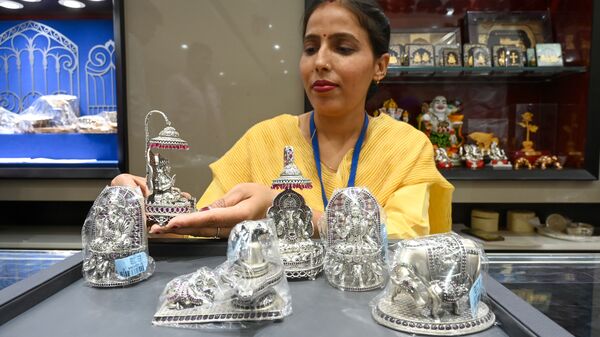
New Delhi: In the run-up to the festival season, the consumer affairs department is planning to publish a list of BIS-registered silver retailers on its website and advertise it through state governments, two government officials directly involved in the process told Mint.
Against the backdrop of mandatory silver jewellery, likely to start in October, the plan also involves making it mandatory for e-commerce platforms to clearly disclose whether silver products sold on their platforms are hallmarked by the Bureau of Indian Standards (BIS), they said.
Currently, around 25,000 silver retailers are registered with BIS, and the proposed government-backed list would provide consumers with an official reference to identify registered sellers. India consumes around 7,000 tonnes of silver annually, with only about 800 tonnes produced domestically. Jewellery accounts for around 35% of India’s silver consumption, while silverware contributes another 15-20%.
“There will be a detailed, district-level list of registered retailers as well as manufacturers, so that consumers can easily identify registered sellers and purchase silver articles from them with greater assurance about the genuineness of the product,” said the second official.
“This will also encourage more retailers and manufacturers to register with BIS, as they would not want to lose customers to registered sellers. Consumers will also know that when they buy a silver product from a registered retailer, it has been sourced through a regulated system,” the official added.
“If any impurity or other problem is found later, consumers can seek redress under the Consumer Protection Act. However, when silver items are purchased from unregistered sellers, consumers may face challenges in establishing the value and purity of the product and seeking redress in case of any dispute,” the person said.
Unlike gold, where mandatory hallmarking has been in place since June 2021, silver hallmarking has so far remained voluntary. The government has been strengthening testing and certification infrastructure and introducing a digital verification mechanism before moving towards mandatory compliance.
BIS currently operates 341 silver assaying and hallmarking centres across 102 districts. It recognises seven fineness grades for silver jewellery, ranging from 800 to 999 parts per thousand. Silver assaying is the process of determining the purity of silver, while hallmarking is the stamping of that certified purity onto the item.
Since September 2025, silver articles submitted for hallmarking have been required to carry a six-digit alphanumeric hallmark unique identification (HUID). The system allows consumers to verify product details through the BIS Care app. Since the HUID portal was launched on 1 September 2025, more than 7.7 million pieces of silver jewellery have been hallmarked, according to government data.
Under the hallmarking system, a hallmarked silver article carries the BIS standard mark, the word ‘SILVER’, its purity grade and a unique HUID. Consumers can use the to check product details through the BIS Care app.
“Jewellery, whether silver or gold, is an asset for Indian families. It is therefore important that it is pure and that consumers know the actual value of the jewellery they own,” said Ashim Sanyal, managing trustee, Consumer VOICE, an NGO working in the field of consumer awareness.
Voluntary adoption of hallmarking has also increased. Hallmarked silver articles nearly doubled to 5.9 million in FY26 from 3.2 million in FY25, indicating growing acceptance of certification ahead of mandatory implementation.
Queries sent to the consumer affairs deparment on Wednesday remained unanswered till press time.