



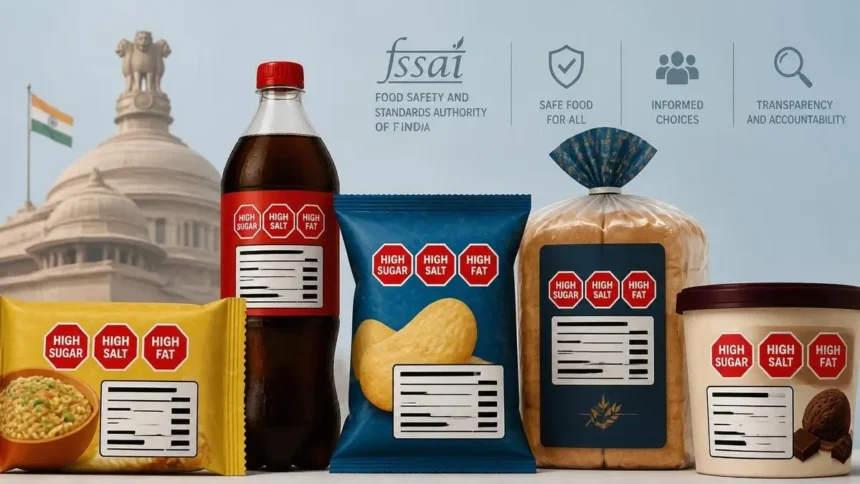
In a move that will reshape the packaged food and beverage industry landscape in the country, the Food Safety and Standards Authority of India (FSSAI) has proposed introducing a framework for the front-of-the-pack warning labels for products that are high in fat, sugar and salt. The regulator has made its submission to the Supreme Court regarding this proposal, which will soon be giving its final judgement on the matter. The SC said this judgement, which it reserved on Monday, will be binding on the Authority.
What is a front-of-the-pack warning labels framework? How is FSSAI proposing to implement the same?
Front-of-pack nutrition labelling (FoPL) is simplified nutrition information on the front of food packaging that aims to help consumers to make better food choices during purchase. This informs consumers regarding products that are high in fats, sugar and salt. Experts believe such a warning label framework will also nudge packaged food and beverage companies to focus on reformulation of their products and reduce the levels of salt, sugar and fat in their products in the long term.
As per its submissions to the Supreme Court, the FSSAI is proposing to provide information relating to added sugar, added fat and salt in pictorial form on the Front-of-Pack. The proposal is intended to provide a simple, prominent and easily comprehensible warning to consumers regarding food products which are high in added sugar, salt and fat.
The warning labels will have three components. This will include a white square shaped background, a red hexagon within the white square and declaration regarding nutrients of concern within the red hexagon. The FSSAI’s proposal states that the warning label would be displayed prominently on the top left of the front of the pack, ensuring clear visibility and legibility to consumers. The proposed warning symbol would be displayed in a font size at least one point larger than used in the nutrition information table at the back of the pack.
In the case of beverages containing “non caloric sweetener”, it has also been proposed for display a warning statement “Contains Non Caloric Sweetener” on the front of the pack.
What are the thresholds for a product to be considered high in fat, sugar and salt ?
The food safety regulator has said that it will adopt threshold values for added sugar, added fat and salt as provided in the Dietary Guidelines for Indians, 2024, issued by ICMR-NIN, for the purpose of Front-of-Pack Labelling (FOPL). For instance, for solid foods, the threshold for sugar has been calculated at 5 per cent energy from added sugar and not exceeding 10 per cent energy from total sugar. In liquids, the threshold for sugar has been calculated at 10 per cent energy from added sugar and not exceeding 30 per cent energy from total sugar, including naturally present sugar.
What are the timelines for the implementation for the FoPL framework?
FSSAI has conveyed to the Supreme Court in its submission that it proposes to adopt the FoPL framework through a “single phase approach.” rather than the earlier suggested “two-phase approach.” It has also said that a period of four months will be reasonably required for issuing and finalising the draft regulations which will involve a consultation process with stakeholders, after which it will finalise and notify the regulations. It has also said that it proposes to keep a voluntary transition period of 365 days for packaged food and beverage companies to ensure they do not face any commercial hardships. Companies usually buy and print packaging material and labels in advance and will require time to exhaust these inventories.
On Monday, the SC questioned FSSAI regarding these timelines and the need for fresh consultation. The FSSAI counsel informed the court that it had earlier proposed to bring a star-rating format, which is diferent from the current proposal.
Is it proposing to exempt some products ?
FSSAI has proposed exempting single-ingredient food products and food products which are inherently rich in fat, sugar or salt, such as ghee, edible oil, salt, sugar, jaggery and honey, subject to the applicability of other requirements under the food safety and labelling regulations.
Published on September 28, 2026