



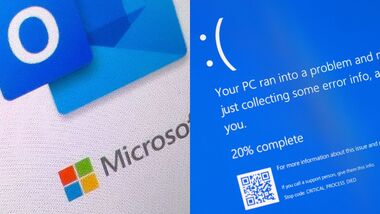
Microsoft on Saturday restored services to all customers following a multi-day disruption. The disruption, which began on November 12, affected access to Exchange Online mailboxes and email connectivity across multiple regions. The Microsoft 365 blackout, which affected Microsoft 365 services, including Outlook, Teams, and AI assistant Copilot, was one of the worst tech outages in history. Microsoft had attributed the disruption to “elevated load” on its infrastructure.
It said the stoppage affected its Outlook email service, as well as Microsoft’s Teams communication platform and the company’s Copilot AI assistant.
It brought governments, courts, healthcare services, businesses, airlines, and banks across more than 70 countries to a near-standstill for hours. The outage also demonstrated how connected the world is and how a small piece of technology can disrupt us all.
In recent years, such tech outages have become more frequent and disruptive.
Before the Microsoft 365 blackout, one of the most disruptive such incidents happened in 2024, when around 8.5 million Windows devices globally crashed. The 2024 (BSOD) incident happened on July 19 when a corrupt configuration file for the CrowdStrike Falcon sensor—an endpoint detection and response tool running at the kernel level in Microsoft Windows—contained a logic error. Affected devices displayed what is known as the blue screen of death, disrupting airlines, airports, banks, hospitals, emergency services, broadcast networks, and retail operations around the world. It is regarded as one of the largest IT outages in history.
In October 2021, a faulty configuration change on’s routers severed network connections, taking down Facebook, Instagram, and WhatsApp offline worldwide for nearly six hours. It happened during routine backbone network maintenance when a command removed the Border Gateway Protocol routes that let other networks find Meta’s systems. It resulted in Meta’s authoritative Domain Name System (DNS) servers becoming unreachable.
On October 20, suffered a 14.5 to 15+ hour regional outage in its US-East-1 hub, disrupting thousands of global websites and applications. The crash was caused by an internal software race condition when a latent concurrency bug occurred between two automated systems—the DNS Planner and the DNS Enactor.
On June 12, Google suffered the biggest and most disruptive global outage in its history when a massive infrastructure meltdown crippled a wide range of services—including Gmail, Google Calendar, Google Drive, Google Meet, and the Google Cloud Platform—and triggered a cascading failure across the internet.