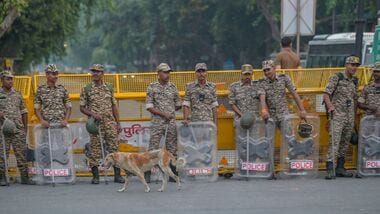
Jantar Mantar is no longer the officially designated venue for protests and demonstrations in the national capital, the Delhi Police said on 12 October.
Instead, three new venues have been designated: Ramlila Ground, Burari Ground and CBD Ground in East Delhi. This comes on a day when Cockroach Janta Party (CJP) leaders sought a date for a peaceful
The decision comes at a time when Opposition parties, civil society groups such as the (CJP), and student organisations including the All India Students’ Association (AISA) and the Students’ Federation of India (SFI) are planning protests and marches around Jantar Mantar in New Delhi.
Jantar Mantar was designated a protest site by authorities after the venue of dissent was relocated from the Boat Club lawns three decades ago.
Earlier, Delhi’s biggest rallies were held on the lawns near India Gate, within sight of North Block and South Block, which house the ministries.
After 1988, when Mahendra Singh Tikait camped there for about a week with an estimated 5 lakh farmers. As president of the Bharatiya Kisan Union (BKU), Tikait forced the then Rajiv Gandhi government to accept key demands such as electricity bill waivers and higher sugarcane prices.
In 1993, the protest venue was officially moved to Jantar Mantar Road, by administrative practice.
in old Delhi and grounds in Burari on the city outskirts were set aside for larger rallies. So, the latest decision adds CBD ground in Shahadra as another option
Basically, the new order means that Jantar Mantar would no longer be the designated protest site. Though, the order mentions three new venues as designated protest sites in the national capital.
Delhi Police said a detailed and revised standard operating procedure (SOP) for organising protests and demonstrations at the three venues would be issued separately.
Jantar Mantar is a centrally located stretch of road Lutyens’ Delhi zone. The location is less than two kilometres from the Parliament, North and South Block which makes it even more significant and strategic location for those who want their message to be heard.
The on Lok Kalyan Marg is also not very far, and so are the main markets and key ministries. No wonder, Time magazine described Jantar Mantar as a “marketplace of grievances” in 2008.
In April 2011, social activist Anna Hazare began a hunger strike at Jantar Mantar for a Jan Lokpal law. Three months later, Hazare resumed his fast and since the crowds had outgrown the road. The venue this time was Ramlila Maidan.
The new sites chosen for protest are located in three different parts of the Delhi. Ramlila Maidan is near old city, Burari is on city outskirts and CBD Ground is in east Delhi. All these three have one thing in common away from the heart of the national capital and distant from corridors of power
Ramlila Maidan is a large ground in Old Delhi and traditionally used to stage the annual Ramlila. The ground has been used for religious festivals, major political rallies and meetings, and entertainment events.
The 10-acre open-air ground is located in New Delhi, situated strategically between the New Delhi Railway Station and Delhi Gate and has been highly regarded as the epicentre of India’s major political shifts.
While the ground is about three kilometres from Jantar Mantar but city’s traffic and congested roads make it paractically distant from the power corridors. It won’t be easy for protesters to march towards Parliament or any other seats of power, as they did during the 20 July protest by (CJP).
On 25 June 1975, Ramlila Maidan was the site of a rally against Indira Gandhi, just before the declaration of the Emergency, where Jayaprakash Narayan recited Ramdhari Singh Dinkar’s famous poem ‘Singhasan Khali Karo Ki Janta Aati Hai’ [‘Vacate the throne, for the people are coming’].
The Anna movement of 2011 held here played a part in the unseating Manmohan Singh’s Congress-led UPA government.
The other protest site, the Burari ground, is roughly 20 kilometres away from Central Delhi and the Parliament of India in outer Delhi.
Situated on the northern outskirts of the capital, the sprawling ground is chosen specifically to accommodate larger crowds while keeping everyday city traffic and central security zones uninterrupted and away from Lutyens Zone.
Like the Burari ground, the third venue for protests, the CBD (Central Business District) Ground is in Shahdara East Delhi. The ground is about 12 kilometres away from the Parliament of India and central Delhi.