



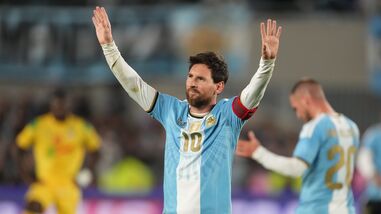
Lionel Messi’s Argentina career began in 2005 with a red card after just 47 seconds on the pitch. Twenty-one years later, it ended with a goal, two assists and an emotional farewell in front of more than 85,000 supporters against Benin at Buenos Aires’ Estadio Monumental.
The contrast between the two nights captures the extraordinary arc of Messi’s international journey.
On 17 August 2005, an 18-year-old Messi made his senior Argentina debut against Hungary in Budapest. He entered the game as a second-half substitute under coach Jose Pekerman, but his first appearance lasted only moments.
Messi was sent off after an altercation with Hungary defender Vilmos Vanczak, leaving the teenager devastated after what was supposed to be the beginning of his international career.
Messi’s early years were marked by expectations of a player who had established himself at FC . He represented his country at the 2006 FIFA World Cup. He scored just one goal in that tournament, but went on to become an increasingly important figure of the national team in the decade that followed.
However, it took another eight years for Messi to reach his first senior major final with the Albiceleste—the summit clash of the 2014 FIFA World Cup. Argentina lost the final 1-0 to Germany, and had it not been for the 2022 FIFA World Cup title triumph, the photo of Messi looking at the World Cup trophy from a distance would have still haunted him and Argentina’s fans.
Argentina’s loss to Germany in the 2014 FIFA World Cup was the first of multiple heartbreaks for Messi. Argentina went on to lose the 2015 and 2016 Copa America finals, both to Chile. So much so that Messi announced retirement from international football, only to reverse that decision two months later.
The breakthrough eventually arrived at the 2021 Copa America. Argentina defeated Brazil 1-0 in the final at the Maracana, giving Messi his first major senior international trophy with his country.
A year later came another landmark. Argentina won the 2022 Finalissima against Italy before Messi captained the team to the 2022 FIFA World Cup title in Qatar. Argentina defeated France on penalties after a 3-3 draw in the final, with Messi scoring twice during the match.
Messi added another major international trophy at the 2024 Copa America, when Argentina defeated Colombia 1-0 after extra time.
By then, his relationship with the national team had changed dramatically from the years when every defeat intensified questions about his international legacy. Yet, Messi rarely allowed the criticism to affect him. He never paid much attention to what his critics had to say.
His final World Cup appearance came in 2026. Messi scored eight goals during the tournament as reached the final, where they lost 1-0 to Spain after extra time.
Although Messi fell short of a second title, that tournament was special in its own way. Messi briefly became the tournament’s all-time highest scorer when he broke Miroslav Klose’s record of 16 goals, only for France’s Kylian Mbappe to surpass Messi with his 22nd goal.
While Messi may not have had a poetic ending on the world stage with possibly another World Cup title, his legacy will surely live on.