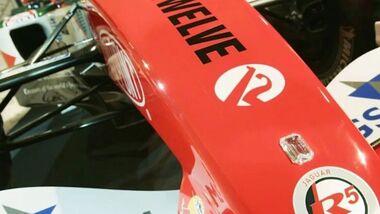
A $300,000 diamond attached to a Formula 1 car disappeared following a crash at the 2004 Monaco Grand Prix. More than 22 years later, the mystery surrounding the precious stone remains unsolved, with former Jaguar Racing officials offering fresh insights into what might have happened to It.
According to BBC Sport, the 1.4-carat diamond was mounted on the nose of Austrian driver Christian Klien’s Jaguar during the Monaco Grand Prix on 23 May, 2004. It disappeared after the rookie crashed on the opening lap and has never been recovered.
The diamond was part of a promotional partnership between Jaguar Racing and the Hollywood film Ocean’s Twelve, starring George Clooney, Brad Pitt and Matt Damon.
was looking to generate publicity at a time when its Formula 1 performances were struggling. Its parent company, Ford, had also decided to withdraw from the sport, leaving the team searching for a potential buyer.
Former team principal Tony Purnell said that his responsibilities had changed during that period.
“My job flipped from primarily running the team to primarily selling the team and finding a new owner or they would shut it down,” Purnell told BBC Sport.
After a successful promotional partnership with Terminator 3 at Silverstone in 2003, Jaguar’s director of communications Nav Sidhu wanted another film collaboration. He negotiated a deal with Hollywood producer Jerry Weintraub for Ocean’s Twelve, whose storyline revolved around stealing a diamond-encrusted Faberge egg.
Jaguar partnered with diamond company Steinmetz to place precious stones on the nose cones of cars driven by Mark Webber and Klien. The diamonds were encased in steel, with a separate, larger stone used for photographs. Their combined value would be around $1 million today.
Webber started the 2004 from 11th on the grid, while Klien began from 14th in only his sixth race.
On the opening lap, Klien made contact with a Jordan car while exiting the Mirabeau corner before crashing into the barriers at the famous Loews hairpin. The Austrian escaped unhurt, but the front of his Jaguar was damaged and the diamond disappeared.
Sidhu soon received a call from the diamond company asking whether it would get its precious stone back.
“I can’t remember what I answered, but it certainly wasn’t ‘yes’,” Sidhu told BBC Sport. He had to wait until the race finished, with 76 laps remaining, before inspecting the damaged car. Sidhu described the wait as feeling like a day and a half.
Several theories emerged, including suggestions that the diamond was fake or that Klien had deliberately crashed his car.
Sidhu dismissed the fake-diamond theory, saying the reputational damage to Jaguar and the company would have been considerable. Purnell also backed its authenticity, recalling that team managing director David Pitchforth had tested it by scratching a window with the stone.
Purnell believes somebody might have picked it up, although he also suggested it could have shattered on impact or been swept away during street cleaning. Sidhu thinks someone may have collected it without realising it came from an F1 car.
He also rejected the suggestion that Klien crashed deliberately. According to Sidhu, repairing the car cost more than the reportedly uninsured diamond. Bringing both cars home and scoring points would have offered greater commercial benefits.
Purnell defended Klien, saying: “He was a young guy, first time, made a mistake, it happens.”
The disappearance generated the publicity Jaguar had been seeking. Purnell recalled that media attention shifted from the race result to the missing diamond, despite Jarno Trulli winning the Grand Prix and Webber also retiring.
“No-one mentioned Jarno Trulli winning the Grand Prix, no-one asked how the Jaguars did. No-one was interested that Mark Webber’s car broke as well. It was, ‘where’s the diamond?'” Purnell said.
Jaguar was eventually sold to Red Bull six months later. Purnell believes the publicity helped demonstrate the team’s commercial potential.
“I think that helped quite a lot because it buzzed the Jaguar team and showed that huge publicity was possible even if you weren’t doing so well,” he told BBC Sport.
More than two decades later, however, the whereabouts of the $300,000 diamond remain unknown.