



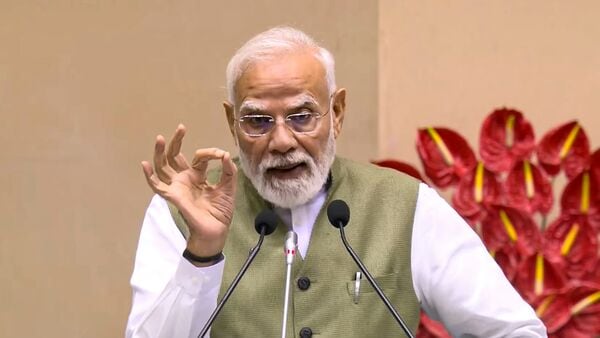
As the second quarter of the fiscal year draws to a close, the government is looking to sustain economic and accelerate implementation of its development agenda. In this backdrop, Prime Minister Narendra Modi is scheduled to chair a two-day Chintan Shivir, or brainstorming session, with Union Cabinet ministers on Wednesday and Thursday at Seva Tirath in New Delhi. Mint explains the importance of this meeting as the government seeks to take stock of work undertaken so far, identify areas requiring greater policy attention and set priorities for the remaining term.
Unlike broader consultations involving the entire Council of Ministers, this session will bring together only Cabinet ministers. The Council of Ministers has 71 ministers, including 30 Cabinet ministers, 5 Ministers of State with Independent Charge, and 36 Ministers of State. The Cabinet-only format is intended to allow a more focused discussion at the highest level of the government. The meeting follows a series of separate interactions held by the prime minister with ministers of state and ministers of state with independent charge.
The Chintan Shivir will focus on three objectives—taking stock of work underway, planning the road ahead, and identifying the next set of reforms and priorities for Viksit Bharat@2047, keeping in mind the upcoming assembly elections in key states, including Uttar Pradesh, Uttarakhand, Punjab, Manipur, Goa, Himachal Pradesh and Gujarat, as well as the 2029 Lok Sabha elections.
The discussions will focus on key governance priorities, including policy reforms, improving the ease of living, and reducing red tape. Ministers aim to highlight high-impact public welfare schemes ahead of the upcoming state and 2029 general elections. Further, the agenda covers strategies to increase economic growth, boost domestic demand and investment, and protect the economy from disruptions in the global supply chain.
The session is expected to bring together work undertaken separately by groups of secretaries, ministries and departments, the Cabinet Secretariat and Niti Aayog. This could help align the work of different arms of government and identify areas where implementation or inter-ministerial coordination needs strengthening.
No. The Chintan Shivir is part of a process that began in 2021 as the government started working on its long-term Viksit Bharat@2047 vision. Ten groups of secretaries were constituted to prepare the Vision@2047 document and develop short- and long-term road maps. The process involved consultations with stakeholders across sectors. Since then, the Council of Ministers has held eight presentations and discussions covering different aspects of Viksit Bharat@2047. The latest two-day session is therefore being positioned as the next stage of an ongoing exercise rather than a standalone brainstorming meeting.
The meeting comes at a crucial time for the government: roughly halfway through its third term and as it looks to translate longer-term development goals into near- and medium-term policy priorities. The economic backdrop adds another layer. While the country’s growth remains strong, global trade uncertainties, geopolitical tensions, energy price risks, and supply chain disruptions can affect the domestic economy. The government, therefore, needs to balance the longer-term Viksit Bharat@2047 agenda with measures to sustain near-term growth and investment. The Cabinet-level discussion provides an opportunity to review what has been achieved, identify gaps and decide where policy attention should be concentrated next.
Queries sent to the spokesperson of the Prime Minister’s Office and the Cabinet Secretariat remained unanswered till press time.