



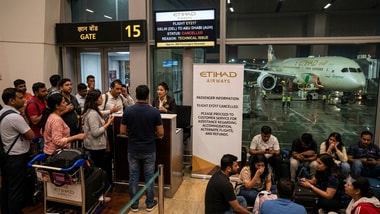
An Etihad Airways flight from Delhi to Abu Dhabi was cancelled late on Saturday evening due to a technical issue with a Boeing 787 aircraft, leaving around 200 passengers stranded.
A number of passengers who had booked tickets for the flight EY217 from Delhi to Abu Dhabi told PTI that the flight was scheduled to depart at 9:15 pm.
All passengers were asked to deboard the aircraft, with the crew telling them that there was a technical issue with the aircraft.
After a few hours, the airline made an announcement that the flight had been cancelled.
The fact that the passengers had already boarded does not by itself remove the cancellation protections guaranteed to them. As per the DGCA, a ‘cancellation’ of a flight means non-operation of a flight that was previously planned and had at least one passenger reserved on it.
Thus, despite passengers having boarded the aircraft, it still qualifies as a cancellation since Eithad did not operate the flight.
Thus the airline is technically required to provide passengers with an acceptable alternate flight or compensation along with a full refund.
For an international flight that has a block time of 2+ hours, the compensation guideline is ₹10,000 OR the booked one-way basic fare + airline fuel charge, whichever is lower.
Airlines are also required to provide passengers who had reported for the original flight with meals/refreshments and, where necessary, hotel accommodation including transfers.
DGCA says that for a foreign carrier (Etihad in this case), the compensation has to be as per its country of origin or the corresponding prescribed amounts by the DGCA.
However, airlines are exempted from providing compensations if the reason for cancellation is beyond their control. This can happen in the case of natural disasters, ATC issues, strikes, government orders, security risks etc.
However, Etihad has just said technical error. As per a PTI report, specific details about what the technical issue was could not be ascertained.
If the issue arises from manufacturing defects or sabotage, this can potentially be treated as an issue beyond Etihad’s control.
However, Etihad’s current Conditions of Carriage do state that it does not override applicable law in a country and its India-specific page also shows DGCA-prescribed compensation amounts depending on flight duration.
While the refund amount is sent to the original source using which the ticket was bought in the first place, the compensation amount, which is a separate component, is paid by cash, bank transfer, or a travel voucher if the passenger agrees.
Passengers should note that an airline cannot force them to accept a travel voucher.