



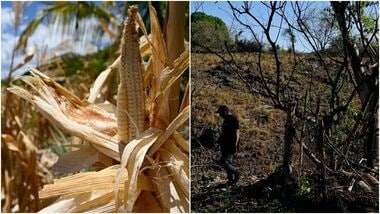
The strengthening El Nino weather pattern has matched the highest intensity recorded on a widely used measure, with its effects already being felt across parts of Central America and .
Zeke Hausfather, a climatologist at and co-author of United Nations climate change reports, said the sea surface temperature anomaly in the tropical Pacific had reached 3.07C. That matches the level recorded during the 2015-2016 El Nino.
Hausfather said September was also likely to become the month with the highest anomaly on record, unless there was an unexpected change during the final week.
His figures, published through the Climate Brink dashboard, use sea surface temperature data from the National Oceanic and Atmospheric Administration (NOAA), collected through satellites and buoys.
The figures are based on daily sea surface temperatures in the Nino 3.4 region of the Pacific and compare them with a 30-year average.
NOAA has also introduced a newer measure known as the Relative Oceanic Nino Index, or RONI. Instead of looking only at warming in the Nino 3.4 region, RONI compares it with warming across the wider tropical belt.
That adjustment is intended to account for the broader warming of the world’s oceans caused by climate change.
Using RONI, the remains below the previous record, although scientists expect it could eventually surpass it.
El Nino is the warm phase of the El Nino-Southern Oscillation, a natural climate cycle in the tropical . It develops when the trade winds that usually move from east to west weaken, allowing warm water that normally gathers in the western Pacific to move towards the east and rise to the surface.
When unusually warm surface temperatures persist for several months, they can alter rainfall, storms and atmospheric circulation far beyond the Pacific.
The resulting weather changes can bring hotter and drier conditions to some regions while producing cooler and wetter conditions elsewhere.
change can also intensify some of the effects associated with El Nino. A warmer atmosphere can hold more moisture, potentially making El Nino-related rainfall heavier. At the same time, increased drying can worsen drought conditions in regions already receiving less rainfall.
Scientists remain divided on whether climate change directly makes El Nino events stronger. However, a recent study using coral skeletons found what researchers described as a “striking amplification” of El Nino events over the past 40 years compared with the pre-industrial period.
The current event is already affecting communities and ecosystems.
In , drought linked to El Nino has contributed to the deaths of animals and damage to crops. Water shortages are also creating problems for the Panama Canal, a key for international shipping.
Around 5% of trade passes through the canal, which relies on reservoir water to operate the locks that raise and lower vessels. Authorities have therefore had to reduce the number of ships able to pass through the waterway.
In Indonesia, meanwhile, El Nino-linked drought has contributed to conditions that have fuelled wildfires across the archipelago.