



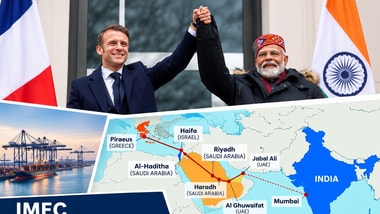
Egypt, Lebanon, Oman and Cyprus have expressed interest in joining the India-Middle East-Europe Economic Corridor (IMEC), Gérard Mestrallet, French President’s Special Envoy for IMEC, said on Tuesday. He was addressing the IMEC Ports Club Working Day in New Delhi alongside Christophe Castaner, Chairman of the Supervisory Board of the Port of Marseille Fos.
Mestrallet, in India from 5-7 October to advance the IMEC project and -India cooperation on connectivity, said that “multiple routes” are key for IMEC as disruptions and risks are affecting existing trade links, reinforcing the importance of developing alternative connectivity options linking India, the and Europe.
“We have eight signatories, and they are heads of state. Any potential extension will only be decided by the eight governments. We hope that in the we could decide to extend the perimeter of IMEC,” Mestrallet said at the press conference hosted by the French Embassy at ITC Maurya in New Delhi.
Mestrallet said an ministerial meeting is expected to be held by the end of this year, where the eight existing signatories could consider expanding the corridor’s membership and geographical scope.
“IMEC is now considered a network of complementary routes in order to be more resilient. If on one particular route there is a blockage, an accident, a technical problem or even a local crisis, the other routes will be available,” Mestrallet said.
Mestrallet named , Lebanon and Oman among countries interested in working with or joining . He also identified Greece and Cyprus as European countries that could be particularly interested in becoming full members.
Any formal expansion would require a decision by the eight existing signatories, he said.
Mestrallet also clarified the position of and Israel, saying both countries were mentioned in the original agreement but did not sign it. “They have not signed because they were not present. It’s Jordan and Israel, although they were mentioned,” he said.
IMEC was announced in September 2023 during the G20 summit by India, the US, Saudi Arabia, the UAE, , Germany, Italy and the European Union. The corridor envisages connecting India with Europe through the Middle East using shipping, rail and other connectivity infrastructure.
Mestrallet said that since its creation, IMEC discussions have taken place at the steering committee level, but there has not yet been a ministerial-level meeting.
“We hope that by the end of this year there will be a ministerial meeting because in the meantime, since the creation of , there was only a steering committee, not a ministerial committee,” he said.
He emphasized that the ministerial meeting could therefore provide an opportunity for the participating governments to consider expanding the corridor.
Mestrallet said would need to work with countries and ports outside the existing group, regardless of whether they eventually become full members.
“In any case, members or not members, we will have to work with them because they want to work positively, and so we have to work with them to find the best possible method — being a full member, an associated member or something else,” he said.
Mestrallet said the geopolitical crises in the Middle East have increased the need for a resilient connectivity corridor.
“The difficulties — 7 October, Gaza, Iran, — have even increased the necessity to have a resilient corridor, offering several possibilities to the market,” Mestrallet said at the event.
He said the disruptions and risks affecting existing trade routes have reinforced the importance of developing alternative connectivity options linking India, the Middle East and Europe.