



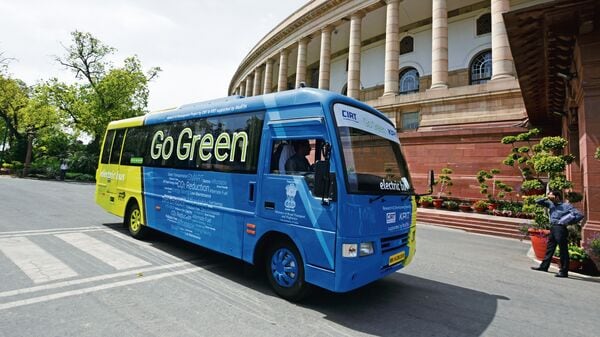
NEW DELHI: A tender under a central government scheme to deploy 3,604 electric buses in smaller cities has been delayed by a month, dealing a setback to India’s push for cleaner public transport and reducing reliance on crude oil imports.
Bids for the tender—the third under the government’s PM e-Bus Sewa scheme—will now close on 7 July, instead of 5 June, according to a 2 June notification from state-run Convergence Energy Services Ltd (CESL), the tendering agency.
This comes amid frequent delays in the scheme, which is key to India’s green mobility transition. The bid closing date for the first tender under the scheme was deferred at least six times.
This tender for 3,600 electric buses was first floated in November 2023, and was slated to close by December. It finally closed in February 2024, according to tender documents and amendment notifications by CESL.
CESL hasn’t cited any reason for the delay in the tendering process.
However, the delay may be to address stakeholder queries, including from bus makers, operators, and city and state governments, pointing to the need for further preparedness for the deployment of e-buses at this scale, said Shyamasis Das, research fellow at New Delhi-based think tank Centre for Social and Economic Progress (CSEP).
“Some past tenders have also been deferred because parties could not agree to clauses in the tender, often related to delivery times, agreements for providing services, and infrastructure readiness,” he said.
The PM e-Bus Sewa scheme, administered by the ministry of housing and urban affairs (MoHUA), aims to support the deployment of 10,000 electric buses across 116 tier-II and tier-III cities. These buses have been allocated to various cities, and tenders for about 98% of them have also been floated.
The second PM e-Bus Sewa tender for 3,132 e-buses was floated in March 2024, but only closed in November 2024 after at least 11 amendments, including some to the bid closing date. The exact number of deferrals in the bid closing date could not be independently ascertained as all amendments to this tender are not in the public domain.
Also, the bid closing date for the country’s largest e-bus tender for 10,900 buses under a separate PM E-Drive scheme was deferred thrice last year.
This comes in the backdrop of India being the world’s third largest market for zero-emission battery-powered buses despite having inadequate infrastructure for charging stations and specialized depots.
Government tenders for state-run buses have occupied a key part of the demand for electric buses, with relatively newer companies such as and PMI Electro securing large orders in previous tenders under the PM e-Bus Sewa scheme and the PM E-Drive scheme.
Queries emailed to the ministry of housing and urban affairs, CESL, EKA Mobility, and PMI Electro remained unanswered.
These two schemes, supporting the rollout of 10,000 and 14,028 e-buses respectively, have formed the government’s two-pronged approach to shifting urban buses towards electric alternatives. The targets e-bus deployment in nine metropolitan cities with populations above 4 million, while the PM e-Bus Sewa scheme aims to reduce operating costs of e-buses in 116 tier-II and tier-III cities.
Both these schemes are backed by the Centre’s PM E-bus Sewa Payment Security Mechanism (PSM), a ₹3,435 crore fund to be used in case state governments default on their routine payments to bus operators and manufacturers.
State governments have had payment default issues in the past, leading to uncertainty for bus manufacturers and operators, said Das, who leads the electric mobility research at CSEP. At the same time, however, the sheer volume of tenders under these schemes could trigger capex shortages for manufacturers, and potentially lead to delays in delivery.
“Charging infrastructure remains the key bottleneck. If depots and highway charging networks are not ready in time, operators face penalties and challenges in starting and maintaining smooth e-bus operation, making it difficult for operators to meet predefined service levels and the impact is felt across the ecosystem,” he said.
NITI Aayog noted in its August 2025 report on mobility envisioned a plan to completely electrify public transportation in five cities to boost adoption of zero-emission buses. As a part of this plan, the government’s think tank suggested the central government provide expert guidance to states and cities on tender design, as well as infrastructure planning required to deploy e-buses at scale and spur demand.

