



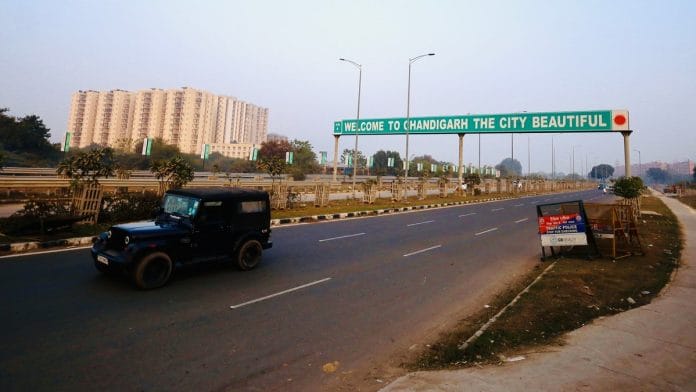
The city, which was designed for smooth traffic flow, would see its carefully planned urban balance disrupted. A metro would require cutting through established sectors, altering road layouts, and increasing interconnectedness in ways that may blur the city’s clear separation of spaces.
It is now inching toward the template of India’s expansive cities, such as Delhi and Bengaluru. It makes the metro argument less rooted in necessity and more in imitation.
If there is one thing this beautiful city was never meant to be was a copy.
The proposed connecting cities like Panchkula, Mohali, Zirakpur and New Chandigarh has been in the works since it was approved by the UT administration and government of Punjab and Haryana in 2023. Phase I is reportedly targeted for rollout around 2027.
Being from Chandigarh, what set the city apart to me was never scale or spectacle, but its efficiency–its orderly design, its measured pace, and a sense of calm that felt increasingly rare in urban India.
“Chandigarh is not designed to support a metro system,” said architect and urban planner Sarika Panda Bhatt to. According to her, under the current land use scenario, a metro in Chandigarh will never get the desired ridership.
Metros have long been positioned as a positive public transport move. More infrastructure must mean better mobility.
But, in this case, the metro risks becoming a misplaced intervention.
Chandigarh is not a city buckling under the weight of its own scale or crying for rapid, heavy-handed development. It is growing steadily. The introduction of the metro would disrupt its balance, making it more chaotic. A label the city has avoided so far.
Its relatively small geographical footprint, moderate population, and low density set it apart from the cities we are comparing it to. Mobility has already been designed into the city—roads are easily navigable, layout is predictable, and its existing public transport, especially buses, is accessible and affordable for most residents. It doesn’t need to be retrofitted decades later.
A project of this magnitude demands space—physical, financial and ecological.
One of the best things about this city is its livability and green cover. Introducing metro lines means years of dug-up roads, traffic diversions, pollution, and strain on local businesses.
Chandigarh risks undermining the very qualities that make it distinct in the first place. And all for a problem it does not have.
A nearly Rs 25,000 crore budget for a project that isn’t an immediate necessity feels excessive, especially when it could be put to a better use. In a race to appear “world-class,” the focus often shifts to building bigger, while ignoring what’s already broken.
Redirecting resources toward strengthening a high-quality bus network in areas like Zirakpur, Tribune Chowk, and the PGI-Mullanpur stretch would be the right approach for the city. It’s been done before in Curitiba, Brazil, where the world’s first Bus Rapid Transit (BRT) system replaced expensive subway plans.
Investing in electric mobility like EV buses, and restoring pedestrian-and cycle-friendly infrastructure, which still remains fragmented and inconsistently maintained, could deliver far more immediate and inclusive benefits.
If the goal is simply to replicate the metro-city model, the solution lies in sharper planning, a better responsive system and a deeper understanding of what the city actually needs.
The very city which once felt like a refuge from the chaos of sprawling metro cities now risks becoming indistinguishable from the disorder it was built to escape.
(Edited by Theres Sudeep)

