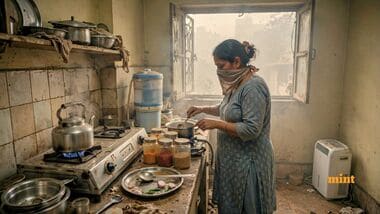
Fine particle pollution was roughly 50% higher inside poorly-ventilated south Delhi homes than outdoors. The study covered 24 homes across four neighbourhoods, PTI reported.
Even homes with working kitchen exhaust systems recorded higher indoors than outside. But their indoor readings were lower than those in homes with poor ventilation.
In poorly-ventilated homes, indoor PM2.5 averaged 119.17 micrograms per cubic metre. The outdoor average was 79.34 micrograms per cubic metre. In well-ventilated homes, indoor PM2.5 averaged 77.34, compared with 56.14 outdoors. This put indoor levels about 38% above outdoor readings in those homes.
PM10 readings followed a similar pattern. Poorly-ventilated homes averaged 138.63 micrograms per cubic metre indoors and 91.19 micrograms per cubic metre outdoors. That put the indoor reading around 52% higher. Well-ventilated homes averaged 89.51 micrograms per cubic metre indoors and 64.81 micrograms per cubic metre outdoors, a difference of about 38%.
Indoor PM2.5 was about 54% higher in poorly ventilated homes than in well-ventilated ones. For PM10, the gap was about 55%. Across all 24 homes, PM2.5 averaged 98.25 micrograms per cubic metre indoors and 67.74 micrograms per cubic metre outdoors.
PM10 averaged 114.07 micrograms per cubic metre indoors and 78 micrograms per cubic metre outdoors. The indoor averages were about 45% higher for PM2.5 and 46% higher for PM10.
Researchers monitored homes in Shaheen Bagh, Jasola Vihar, Batla House and Okhla Vihar. They collected readings from February to April 2023.
They measured indoor pollution in kitchens and outdoor pollution on balconies. Each home was monitored for 8 hours each day over 3 consecutive days.
The researchers skipped night-time monitoring because of privacy concerns. They classified homes according to whether working kitchen chimneys or exhaust fans operated during monitoring.
The study linked better ventilation with lower indoor particle levels. Still, both groups recorded higher average particle levels inside kitchens than on balconies.
The researchers linked higher indoor readings to household activities and poor ventilation. They also pointed to entering homes from outside.
Cooking, cleaning, smoking and burning incense can add particles to indoor air. Poor ventilation can allow indoor-generated particles to accumulate. The team did not measure how much each contributed to cooking, traffic, or dust.
The team included researchers from in New Delhi. Researchers from Jazan University in Saudi Arabia also took part. Others came from Baba Ghulam Shah Badshah University in Rajouri, Jammu and Kashmir.
The journal Discover Environment published the study in 2025. The researchers said improving ventilation, maintaining exhaust systems and reducing indoor pollution sources could help.