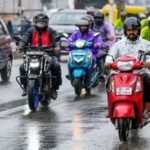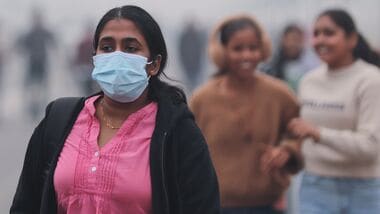
Pollution filled Delhi’s air as the air quality index a day after Diwali touched the ‘severe’ category in parts of the national capital. In the early hours on Monday, around 4:20 am, the air quality station at ITO recorded an alarming AQI of 406, according to data shared by the Central Pollution Control Board (CPCB).
The air quality deteriorated while Stage III of the Graded Response Action Plan (GRAP) is in force across Delhi-NCR.
Rajiv Chowk clocked an AQI of 381 at 1:30 am, while the area surrounding South Extension registered an AQI of 360 at 4:00 am.
The overall air quality in Delhi remained in the ‘Very Poor’ air quality bracket, at 366, around 7 am on Monday, according to the Commission for Air Quality Management in National Capital Region and Adjoining Areas (CAQM).
On Diwali light (late Sunday), air quality at 20 monitoring stations slipped into the ‘severe’ category, with the overall Air Quality Index standing at 371 at 10 pm.
Meanwhile, a thick layer of smog engulfed several parts of the city, significantly impairing visibility early in the morning, including the Inderlok area.
Despite restrictions on bursting firecrackers, several parts of Delhi continued to witness their use on Sunday evening, with reports of fireworks emerging from areas, including Pitampura, Burari, Mayur Vihar and parts of Lutyens’ Delhi.
Ahead of Diwali, the Delhi government had appealed to people to comply with the Supreme Court’s directions on sale and use of green firecrackers.
The District Magistrate (East), in an order, had permitted the bursting of green firecrackers only on November 7 and 8, between 6 am and 7 am and 8 pm and 10 pm.
Residents reported that firecrackers were being burst in outer Delhi’s Pitampura and Burari, with the intensity particularly high in Burari.
Similar reports came from Mayur Vihar, while people in the Bishambardas Marg area and Lutyens’ Delhi said fireworks continued, although the intensity had reduced slightly.
Of the 59 monitoring stations that recorded air quality at 10 pm, 20 recorded AQI in the ‘severe’ category, six in the ‘poor’ category and the remaining 33 in the ‘very poor’ category.
Sonia Vihar recorded the worst air quality, with an AQI of 463, followed by Jahangirpuri at 450. Burari, Alipur and Punjabi Bagh were among the other areas recording high pollution levels.
Sonia Vihar, Jahangirpuri, Punjabi Bagh, Burari, Okhla and Rohini were among the monitoring stations that remained in the ‘severe’ category throughout the day.
The city’s air quality had already been close to the ‘severe’ threshold in the evening, with the AQI standing at 371 at 7 pm.
While roads across much of the capital remained relatively deserted during the day, firecracker bursting picked up from around 5-6 pm, with celebrations gathering pace as night fell. As the cracker-bursting continued, smoke accumulated over several neighbourhoods, adding to the existing pollution burden.
Several social media users took to X to report the deteriorating conditions, flagging the strong smell of smoke, reduced visibility and difficulty breathing as celebrations continued through the night.
The city’s average AQI for the day settled at 376 in the ‘very poor’ category, compared to 369 on Saturday, amid a layer of smog and reduced visibility.
According to the Central Pollution Control Board (CPCB), an AQI between 0 and 50 is classified as ‘good’, 51 and 100 as ‘satisfactory’, 101 and 200 as ‘moderate’, 201 and 300 as ‘poor’, 301 and 400 as ‘very poor’, and 401 and 500 as ‘severe’.
The Air Quality Early Warning System (EWS) has forecast that Delhi’s air quality is likely to slip into the severe category from November 9 and remain there for the subsequent few days.
Weather and air quality experts have attributed the anticipated deterioration to unfavourable meteorological conditions, vehicular emissions, Diwali celebrations and the ongoing peak stubble-burning season in neighbouring states.
A ventilation index below 6,000 square metres per second, coupled with an average wind speed of less than 10 kilometres per hour, is unfavourable for the effective dispersion of pollutants, according to the EWS.
PM2.5 remained the predominant pollutant in the national capital on Sunday, with firecracker emissions adding to the particulate matter levels.
According to the Decision Support System (DSS) for Delhi, the transport sector was set to be the largest contributor to the city’s pollution on Sunday, accounting for 19 per cent. Stubble burning was set to contribute 3.5 per cent, with forecasts suggesting the contribution might remain around 2.99 per cent on Monday.
Meanwhile, Delhi Minister Kapil Mishra launched a scathing attack on Aam Aadmi Party (AAP) national convenor Arvind Kejriwal, alleging that a campaign was being orchestrated at Kejriwal’s residence to target the Hindu festival of Diwali and Sanatan Dharma under the pretext of pollution.
In a post on X, Mishra claimed that leaders and paid celebrities would be rolled out to run a targeted narrative.