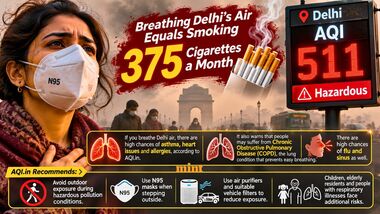
Breathing Delhi’s polluted air is now comparable to smoking 12.5 cigarettes every day. The alarming estimate comes as the national capital battles another severe pollution crisis. According to AQI.in, Delhi’s Air Quality Index (AQI) reached 511 on Sunday morning. The reading was recorded on November 15 at 7:11 AM. The pollution level falls under the hazardous category, posing serious health risks.
AQI.in estimates that exposure is equivalent to smoking 87.5 cigarettes weekly. The monthly equivalent stands at 375 cigarettes.
However, these figures represent estimated exposure to pollution, not the actual effects of smoking. The calculation uses average PM2.5 concentrations over the previous 24 hours.
Delhi recorded a PM2.5 concentration of 331 micrograms per cubic metre. Meanwhile, PM10 levels reached 349 micrograms per cubic metre.
Carbon monoxide stood at 1,657 parts per billion. Nitrogen dioxide measured 22 parts per billion. Sulphur dioxide stood at six parts per billion. Ozone levels remained at three parts per billion.
The capital ranked 15th among the world’s most polluted cities during the reported period.
AQI.in’s historical data show significant fluctuations in pollution over the previous 24 hours. peaked at 577 around 7:31 AM on Saturday. Conditions improved during the afternoon, reaching 248 around 4:01 PM.
However, pollution increased again after sunset. The index crossed 400 in the evening and continued to rise overnight. By Sunday morning, the AQI had climbed to 511.
The pollution calendar recorded an even-higher reading of 666 on November 9. November 12 witnessed another alarming reading of 547. Delhi records worst pollution month since 2020
AQI.in’s annual analysis identifies November 2026 as the most polluted month in its displayed records. The monthly AQI figure stands at 438.
Meanwhile, August 2020 recorded the lowest monthly reading of 74. The annual AQI average increased from 154 in 2020 to 179 in 2025. However, the 2026 average currently stands at 164.
AQI.in recommends avoiding outdoor exposure during hazardous pollution conditions. Residents should use N95 masks when stepping outside. Air purifiers and suitable vehicle filters can also reduce exposure. Children, elderly residents and people with respiratory illnesses face additional risks.
If you breathe Delhi air, there are high chances of asthma, heart issues and allergies, according to AQI.in. It also warns that people may suffer from Chronic Obstructive Pulmonary Disease (COPD), the lung condition that prevents easy breathing. There are high chances of flu and sinus as well.
Delhi’s pollution remains considerably worse than other major Indian cities. Kolkata recorded 248 while Mumbai stood at 198. Bengaluru recorded 148, highlighting Delhi’s dangerous .