



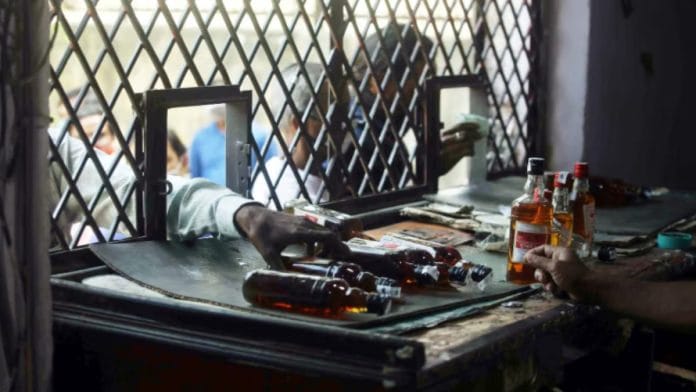
Since the bulk of citizens did not regard drinking as a crime, they had no respect for the prohibition laws and did not cooperate with the police and vigilance associations to enforce them. There was widespread defiance of the unwanted laws. Illicit manufacture and sale of liquor became widespread and made a mockery of the laws. Law was brought into contempt and legal offences increased.
We have been having similar experiences in India since 1947. People are beginning to doubt the wisdom of legislation of this kind to make men moral by law and governmental force.
A number of auxiliary repercussions unfavourable to decency in social life and purity in administration have made themselves felt in India as in America before the cancellation of prohibition.
There has been much illicit distillation of country liquor throughout the countryside (and even in towns and cities) by classes and groups thrown out of employment by the abolition of legitimate toddy tapping and the manufacture and sale of liquor under licence. It is said that the only cottage industry that is flourishing in the countryside is that of illicit distillation and sale of toddy! The big traders (some of them) have taken to smuggling foreign liquor and secret sale in the black market. It has become a lucrative trade for them. Habitual addicts succeed in obtaining permits on grounds of health for limited quantities but they manage to exceed the limitation by collusion with the licensed traders.
Foreigners and army men are permitted to have drinks under permit which is obtainable liberally by them.
Before the prohibition laws came into force, the women of the working class were largely free from the drinking habit. They censured their menfolk for indulging in the costly habit which cut into household finance.
The higher castes were largely free from the habit on the whole, though It was only the Jains and Brahmans who observed the rule against drink strictly, barring exceptions. The other high castes Indulged in drink in moderation and mostly on festive occasions.
This example had a great social effect in keeping the drink evil within limits. Alcoholism in India never rose to the dangerous limits that it did in Europe and America, where it has become a serious economic and social evil.
The quantity of wine consumed by the average farmer in France and Italy is enormous and has had deleterious effects on the efficiency of the population.
But the question is whether this social and moral evil, (which drinking becomes when It passes wholesome limits) is a suitable subject for governmental legislation. Government has to act by force and by automatism and uniformity which can only be worked satisfactorily by a paid whole-time staff. The administrative machine is not likely to have any genuine interest in temperance or any of the moral fads that may be taken up by governments at the pressure of propagandists. Pacifists, for example, urge unilateral disarmament. If this is applied to the police and the police force reduced to any extent, it is not hard to anticipate the devastating effects it will have on law and order and security of life and property.
Prohibition has been introduced without widespread discussion on the different aspects of the question out of a deference to the opinions or feelings of Mahatma Gandhi.
Law has a chance of success only where it can secure the willing consent and support of the bulk of the citizen body. A minority of recalcitrants can then be dealt with by force successfully.
The sphere of law is the sphere of force. The sphere of moral action on the other hand is the realm of freedom and self-determination.
Religion and morality derive their quality and essence from a free motivation and response of the inmost self of man to the mysterious element in the universe and to the sense of values operating in motives and Intentions issuing in plans of life and fulfilment.
Force will only produce outer conformity, if it is efficiently applied with punishment that cannot be easily escaped.
And enforced religion and morality are no religion and morality at all. “Compulsory religion is better than no religion,” said a religious leader. “I fail to see the difference”, answered a lay citizen.
The first thing to consider in this controversy is that drinking an intoxicating stuff is not a crime by itself. It is true that drinking to Intoxication leads to loss of self-control temporarily until the effects disappear after sleep and rest in a few hours. But the damage, if any, is confined to the individual, if he does not go in for drunken and disorderly conduct in public, producing disgust in and inconvenience to others.
Generally speaking, law should come into operation only where an individual impinges on others disadvantageously through the unwise exercise of his freedom. It is truly said that a man’s freedom to swing his stick or umbrella stops at the tip of the nose of another in his vicinity!
In extreme cases, we may admit that an exercise of freedom that damages only the agent is also contrary to civilised law. The well-known instance is suicide.
Even in suicide, the agent may try to evade his moral obligations to his family or dependents. It is a question whether the law against suicide should apply in cases where the ill effects concern only the individual. In such cases, it may be that the law against attempted suicide needs reconsideration. From this point of view, euthanasia or the attempt to died by suicide by slow poison without painful effects is defended as permissible by some social thinkers.
We know that in India Jain saints are respected for the act of courting death by fasting when undertaken at the end of life to quit life voluntarily instead of being subject to the vicissitudes of the bodily condition.
A parallel case where similar problems arise is vice-sexual or other. Rape definately is a crime because it violates the freedom and dignity of the woman. But if the woman consents and she is adult and free from contractual obligations by marriage to a different person, namely her legally wedded husband, the sexual relation between that man and that woman would concern only themselves alone. Law will have no ground to enter and interfere with them. But if a child appears, they will assume legally enforceable obligations to the child in respect of maintenance and upbringing.
Thus if an individual drinks in moderation in a manner that does not affect his normal conduct, law should have no ground to interfere. Many people can take a certain amount of drink without any visible effects on their efficiency in work or decency of behaviour in society. Law has no business to punish such persons for the mere act of drinking. This is where the prohibition law errs against freedom and personality. It empowers the police to book any man or woman for merely drinking and containing liquor, if only the smell thereof is detectable!

