



Suggestions are also made that Washington is attempting to drive a wedge between China and Iran that has the potential to foster mistrust in Tehran while gaining leverage for future negotiations. The commentator wrote, the US actions amount to a classic case of “the thief crying ‘stop thief.’”
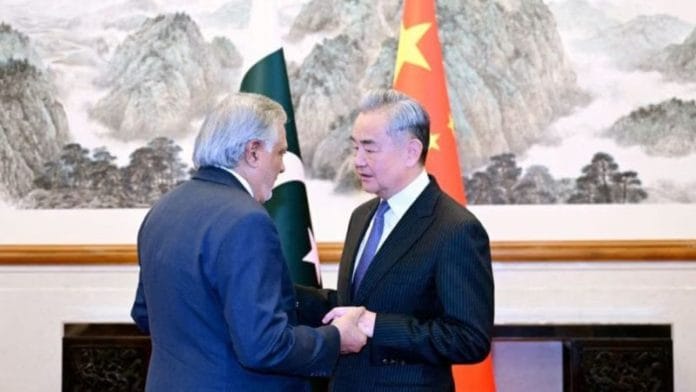
Analysts that Foreign Minister Wang Yi conducted extensive outreach, China’s Middle East envoy engaged in mediation, and Beijing, alongside Pakistan, advanced a peace initiative. China, thus, is being projected as a responsible third party. US actions, by contrast, are attributed to strategic anxiety over China’s growing role and its reputation as a neutral broker, implying that “Beijing is not taking sides, but building a ladder.”
Some commentators claim Pakistan’s mediation was on before a secure backchannel linked senior officials in Beijing and Tehran. While details remain opaque, these accounts suggest a turning point came with a Chinese guarantee to ensure the safety of the Iranian delegation, reportedly backed by Beijing’s leverage with Washington.
Analysts also portray China’s role as a , working alongside Pakistan’s more visible mediation to break the ceasefire deadlock. Three factors are said to have driven this approach. First, economic stakes: the Strait of Hormuz carries around 20 per cent of global seaborne oil, and instability directly affects China’s energy security. Second, diplomatic positioning: by invoking the UN Charter and a five-point initiative, China casts itself as a multilateral, rules-based actor in contrast to US unilateralism. Third, indirect influence: with Pakistan leading on the ground, China shapes outcomes from the sidelines. This will allow China to expand its diplomatic role while limiting risk and exposure.
Huang Jing, Distinguished Professor at Shanghai International Studies University, these sentiments, arguing that China is increasingly playing a stabilising role in a turbulent world and becoming a mainstay in managing global uncertainty. He added that Beijing’s commitment to stable China-US relations is of broader significance for global stability and development.
Shen Yi, Professor of International Politics at Fudan University, that the US-Israel strike on Iran was expected to quickly destabilise the regime and produce a pro-US outcome, but that was misplaced optimism. Iran instead sustained its military response, retaliated with missiles and drones, disrupted the Strait of Hormuz, and dragged the conflict into a prolonged stalemate.
According to Shen, the US now faces a strategic deadlock. It cannot credibly declare victory, withdraw without appearing defeated, or achieve its objectives through airpower alone, raising pressure for a risky ground intervention. Meanwhile, the conflict is becoming a costly quagmire, with rising oil prices, domestic strain, and no clear resolution. Escalation risks are also growing, including potential strikes on nuclear facilities and even the prospect of a wider regional or nuclear crisis.
, Director of the China-Arab States Research Institute at Ningxia University, also said that the US and Israel underestimated Iran’s resilience and resolve, and that none of their stated war objectives have been achieved. He outlined four possible trajectories: a negotiated settlement, a unilateral US declaration to end the war, a prolonged conflict, or further escalation.
Taking a cue from the US-Iran conflict, some d that a direct US-China confrontation now remains unlikely for at least 50 years. They that the war has exposed key limitations in US military capacity and political resolve. The Chinese narrative is that Iran’s hardened, deeply buried infrastructure blunted US bunker-buster capabilities and prevented a quick victory. Second, the cost imbalance between low-cost Iranian drones and expensive US air defence systems has strained American stockpiles and exposed limits in its industrial base. Third, allied and domestic support has been limited for the US. Most allies have stayed out, while domestic opposition and political pressure have constrained sustained engagement, so goes the Chinese commentary.
Beijing is cast as the real actor behind the negotiations, with much of the online discussion suggesting that Iran came to the table largely due to China’s intervention. This framing implicitly diminishes Pakistan’s role, which portrays it as lacking the independent weight and agency to act as an effective mediator and instead functioning as a proxy for Chinese interests. Such a narrative and arrangement are ultimately working in Beijing’s favour. It allows China to shape outcomes decisively while remaining in the background and projecting influence without assuming direct responsibility.
Sana Hashmi, PhD is a fellow at the Taiwan-Asia Exchange Foundation. She tweets @sanahashmi1. Views are personal.
(Edited by Ratan Priya)

