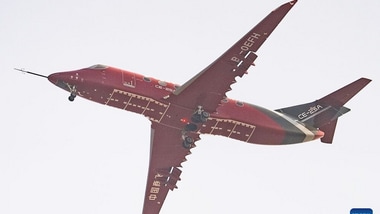
China has successfully completed the first piloted flight of its 19-seat CE-25A electric passenger aircraft, marking a major development in battery-powered aviation. Developed by the Commercial Aircraft Corporation of China (COMAC) and its partners, the 10-tonne aircraft took to the skies in Shandong province on November 14, 2026. The flight is a significant achievement towards the commercialisation of electric aircraft in regional passenger transport.
The CE-25A can carry up to 19 passengers over distances of approximately 400 km. The aircraft is powered by an electric propulsion system rather than traditional fuel-powered engines. According to state news agency Xinhua, citing COMAC, the aircraft performed normally during its first crewed flight, with all performance indicators meeting expectations. It still requires additional testing and regulatory certification before going into commercial service, though.
According to official press release, the took 57 minutes and 46 seconds, and the plane was in the air for 16 minutes and 38 seconds, according to the state broadcaster CCTV. It covered a distance of 60.4 km during the test. There were two pilots and a flight-test engineer on board.
The CE-25A’s take-off weight is 10 tonnes, and the cruising speed is 300 kmph. It is intended to be flown at about 2400 metres and is therefore suitable for short-range regional flights, not long-range flights.
The CE-25A is different from conventional passenger aircraft, which have only a single ducted fan along the length of their wings. The fans are driven by electric motors that draw power from the aircraft’s battery system. The design of distributed electric propulsion eliminates the need for the usual engine configuration but still requires testing to assess efficiency and benefits.
The aircraft is being built with the help of COMAC, Chinese battery major CATL, and other partners from Shanghai Jiao Tong University. The project combines expertise in aircraft manufacturing, battery technology and aviation research to advance electric passenger transport.
On February 2, 2026, the CE-25A flew the first-ever unmanned, autonomous mission. This was followed by 19 unmanned flight-validation exercises. The November 14 test marked its first flight with pilots and a flight-test engineer on board.
The flight was successful, but the plane is not yet ready for commercial passenger service. The CE-25A is being developed in accordance with CCAR-25, the airworthiness regulations for transport aircraft in China.
The report says the Civil Aviation Administration of China (CAAC) has received its application for a type certificate. The application’s acceptance, however, does not guarantee final certification of the aircraft.
The CE-25A will need additional flight tests and certification approval before it can transport paying passengers. The development of the aircraft may provide valuable insight into the potential of battery-powered planes in regional airspace in the future.