



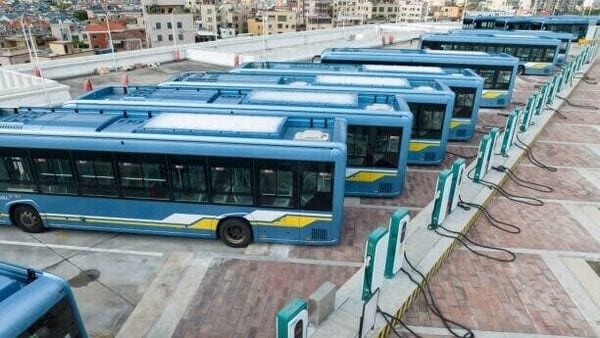
Convergence Energy Services Ltd (CESL) has added Haryana’s demand for 450 electric buses to its third tender under the Centre’s PM E-bus Sewa scheme, taking the total order size to 4,054 buses, along with changes to the conditions to sweeten the deal, documents reviewed by Mint showed.
The tender, whose closing date has been deferred at least five times, now allows a single entity to bid for 2,717 buses, up from 2,400 earlier.
The tender also allows bidders to include fresh equity raised in 2026-27 towards their net worth, a significant change given that electric buses cost ₹1.2-1.3 crore—more than twice as much as diesel buses, according to industry stakeholders’ estimates.
“The equity infusion makes sense because half of FY27 is already over, so fundraising during this period can be counted. The aggressive bidders are largely new-age manufacturers that lack the turnover of incumbents and therefore rely on equity infusions, said Shyamasis Das, who leads the electric mobility research vertical at the New Delhi-based think tank, the Centre for Social and Economic Progress (CSEP).
CESL confirmed the changes in an email response to Mint, noting that they are in line with previous electric bus tenders.
Mint‘s queries emailed on 15 September to the ministries of housing and urban affairs and heavy industries, as well as the Government of Haryana, remained unanswered.
Of Haryana’s 450 e-buses, 100 each to be deployed in Gurugram and Faridabad will not qualify for PM E-bus Sewa incentives but will be covered by the central government’s PM E-bus Payment Security Mechanism scheme, according to tender documents.
The Centre has created a ₹3,433-crore fund to ensure timely payments to bus operators by government-run transport agencies, including state and municipal agencies.
Payment defaults by state transport agencies deterred e-bus makers and operators from running massive fleets in India’s major urban centres.
The PM E-bus Sewa rollout, however, remains in its early stages: concession agreements covering 4,470 e-buses across 56 cities have been signed, with the Centre providing a subsidy of ₹24 per kilometre. The Union government has earmarked ₹20,000 crore for the scheme through FY29, aiming to support the deployment of 10,000 urban electric buses across 116 tier-II and tier-III cities.
While the city-wise bus allotment has been finalised, about 98% of the buses have also been tendered. Buses under the scheme were tendered in three parts. The first tender closed in March 2024, the second in November 2024, and the third is set to close in 2026.
“Since this is the last tender under the scheme, it may be giving new-age manufacturers and operators a chance by ensuring turnover and net-worth requirements don’t become a barrier,” Das said.
He added that key concerns before these “big ticket” are ensuring that new-age manufacturers have the capacity to produce these buses within the tender timelines, while operators, who are part of the consortium, must deploy large crews to run these buses efficiently.
The PM E-bus Sewa scheme is part of the government’s push to electrify mobility and reduce dependence on imported crude oil. The shift has gained momentum as the government increasingly directs subsidies from two- and three-wheelers towards electric buses and trucks.
The Union heavy industries ministry in April said it was working on a new scheme to provide cheaper financing for electric buses and trucks to boost adoption in these segments.
Mint reported on 31 August that the scheme would target cheaper loans for 50,000 and 50,000 e-buses, along with similar benefits for charging infrastructure. As of May, the scheme was slated to have an outlay of ₹9,852 crore.
The delay in closing the PM E-bus Sewa third tender comes after India’s largest e-bus tender for 10,900 e-buses under the was also delayed by at least four months. Mint also reported earlier that, of the first two PM E-bus Sewa tenders for 3,825 and 3,332 e-buses, respectively, around 2,600 e-buses across various states were still awaiting contractual approvals.
India is the world’s third-largest e-bus market, with sales reaching 5,358 units in FY26, a 37% year-on-year increase, according to the government’s VAHAN registry of new vehicles.