



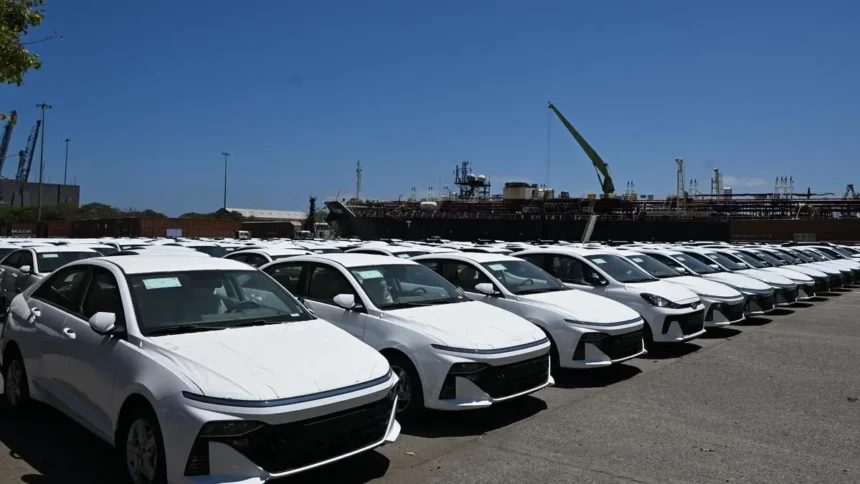
Retail sales of both passenger vehicles (PVs) and two-wheelers recorded the best-ever September, growing 33 per cent and 32 per cent, respectively on a year-on-year (y-o-y) basis, the Federation of Automobile Dealers Association (FADA) said on Tuesday.
PV retail sales grew to 4,27,213 units during the month compared with 3,23,391 units in September 2025. Similarly, two-wheeler sales grew to 17,90,188 units last month as against 13,45,153 units in the corresponding month of 2025.
Three-wheeler retail sales also grew 22 per cent y-o-y to 1,32,570 units in September as compared with 1,08,444 units in September last year.
Commercial vehicles, meanwhile, crossed the one-lakh mark for the first time, growing by around 38 per cent y-o-y to 1,03,557 units during the month as compared with 75,246 units in September last year, the monthly retail sales data shared by FADA said.
Overall, vehicles sales across categories grew by 32 per cent y-o-y to 25,36,920 units in September as compared with 19,24,546 units in the same month last year.
“Dealers expect October to deliver the festival pick-up that September deferred: with Navratri (October 11-20) and Dussehra, demand held back during Pitru Paksha should convert into a concentrated burst of deliveries from mid-month, even if the first 10 days stay quiet,” said Sai Giridhar, President, FADA. “Booking pipelines are already building for 63 per cent of dealers. Importantly, with the GST 2.0 anniversary now behind us, October will be the first month to offer a clean, like-for-like y-o-y comparison.”
He said the October to December period sits in the window of the festival season, followed by the wedding season and year-end buying.
“FADA would, however, read the quarter for what it is. October-December 2025 was the first full quarter after GST 2.0 and absorbed considerable pent-up demand, a demanding base, so the quarter’s real signal will be festival conversion in the showroom, not year-on-year optics. The decisive variable is affordability: a substantial part of the GST 2.0 benefit still sits with the consumer, but successive input cost-led price increases are narrowing that cushion, and dealers rightly flag this as their top risk,” said Giridhar.
Besides, manufacturer dispatch discipline matters, with PV inventory already at 43-45 days. The structural anchors remain supportive — rural consumption, infrastructure-led goods movement, a strong launch calendar and steadily deepening electrification — each a thread of the broader India growth story, he noted.
“Overall, the next three months appear cautiously optimistic — strong festival expectations tempered by a demanding base, with festive conversion, affordability and inventory discipline the key monitorables,” he added.
Published on October 6, 2026