



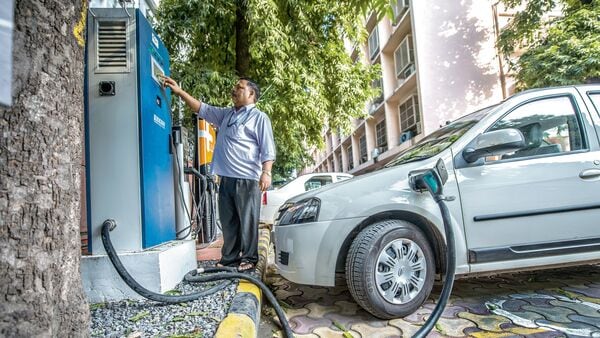
A government-appointed expert panel has recommended that all new cars sold or registered in Delhi-NCR be electric by 2030, setting out one of India’s most aggressive roadmaps yet for a shift away from petrol and diesel vehicles as the region heads into another winter of hazardous air pollution.
The panel, constituted by the Commission for Air Quality Management (CAQM) under the environment ministry, has proposed a phased electrification mandate for cars: 20% from 2027, 45% in 2028, 70% in 2029, and 100% in 2030.
The recommendations come weeks ahead of Delhi-NCR’s annual pollution season, when air quality routinely deteriorates into the ‘severe’ category between November and January. The recommendations extend a push already under way in Delhi, where the Delhi EV Policy 2026 mandates no registration of two-wheelers with internal combustion engine (ICE) from 1 April 2028, and ICE three-wheelers from 1 January 2027.
The Delhi EV Policy 2026 also says the Delhi government intends to “bring out electrification mandates for four-wheelers in future as well as aim to make a framework for disincentivising polluting vehicles that use inefficient fuels”.
The interim report was prepared by a 15-member panel led by Ashok Jhunjhunwala of Indian Institute of Technology, Madras, and comprising government officials and subject-matter experts. The panel was set up by CAQM in December to draft a strategy to reduce air pollution in the National Capital Region (NCR), where vehicular emissions are among the sources of pollution.
Mint reported in February that a similar electrification plan, with the same targets, was being drafted and would be presented to automakers.
“Recognizing the criticality of the pollution problem, this Committee has little option but to recommend aggressive timelines for implementing zero-emission transportation in the Delhi-NCR region. It requires the industry to go beyond what it is doing today and come up with multiple quality and affordable products, with a firm belief that that by aligning to these recommendations, the Indian industry can position itself as global leader in this area,” the report’s executive summary said.
The report, submitted to CAQM in August and published on Thursday, also recommends accelerating the scrappage of older vehicles. It calls for BS1, BS2 and BS3 vehicles to be scrapped immediately, followed by BS4 vehicles by 2030, BS6 two-wheelers by 2035 and BS6 cars by 2040.
Delhi registered 850,443 new vehicles in fiscal year 2026 (FY26), including 568,420 two-wheelers and 202,330 cars, according to the government’s VAHAN registry. Electric vehicles (EVs) accounted for 12.65% of new vehicle registrations, with 107,648 EVs sold during the year.
Automakers had opposed the electrification mandates when they were proposed by the Delhi government ahead of the new EV policy. Then Society of Indian Automobile Manufacturers (Siam) president Shailesh Chandra said incentives, rather than mandates, were the best enablers of clean mobility.
Queries emailed to the ministries of heavy industries and road transport and highways, Delhi’s transport ministry, Siam, and carmakers Maruti Suzuki, Tata Motors Passenger Vehicles, Mahindra & Mahindra and Hyundai Motor India seeking comment were not answered immediately.
The CAQM panel has also recommended financial incentives for EV adoption, which remain more expensive than petrol and diesel vehicles, although price parity in two-wheelers has nearly been achieved, according to a December 2025 KPMG report. It has also called for incentives to retrofit ICE vehicles with electric powertrains.
The panel’s case rests on the availability of a zero-tailpipe-emission alternative at a time when air pollution remains a persistent problem in the region.
“The Air Quality Index (AQI) in the National Capital Region (NCR) has reached critical levels peaking to over 460 and severely impacting the health and quality of life of the 60 million people living in the region, warranting solutions to be implemented urgently,” the report’s executive summary said.
“In the sector of our focus, a zero-emission technology – Battery Electric Vehicles (BEVs) – already exists for on-road vehicles as well as construction, mining, and agricultural equipment. Battery technology, charging infrastructure and vehicle economics are improving rapidly, making BEVs increasingly affordable and practical. The key to adopting this technology at scale thus relies on effective Change Management,” the summary added.
Some experts say the CAQM expert panel recommendations are a sign that policymakers are acknowledging the need for a shift in approach to curb air pollution.
“There are clear signals that policymakers are acknowledging a radical shift in approach is needed to curb the problem of air pollution. The move from CAQM to enforce mandates will be significant if it is implemented because its ambit covers the entire NCR region and not only Delhi,” said Sharif Qamar, associate director of transport and urban governance at Delhi-based think tank The Energy and Resources Institute (Teri).
“When the mandates for CNG were introduced two decades back, similar conversations happened like the one we are seeing on EVs. But given the air pollution problem has now stayed for over a decade, a radical move towards zero emissions vehicles is needed,” Qamar added.
India has iterated a multi-fuel pathway to clean mobility, focusing on various powertrains such as biofuels, hybrid vehicles, electric vehicles, and hydrogen vehicles to reduce vehicular emissions and make India a net-zero emission country by 2070.