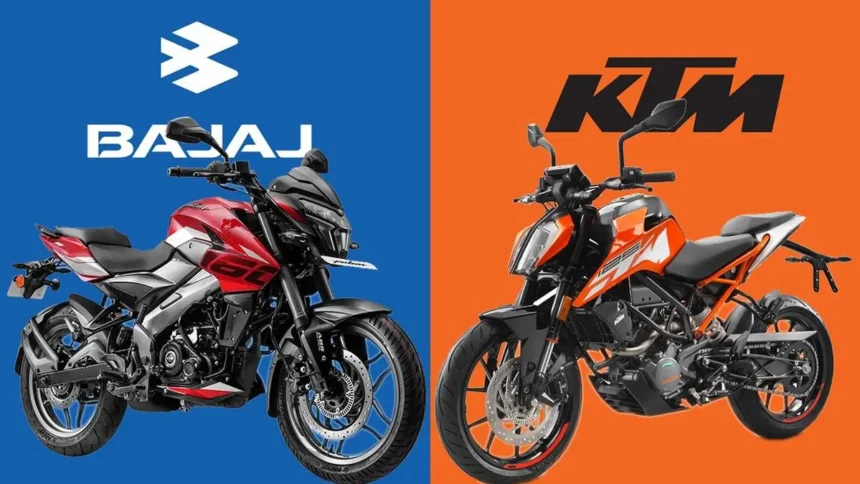
It’s been nearly a year since Bajaj Auto took control of the financially troubled Austrian motorcycle maker, KTM, and now the Indian automaker is seeking to combine Pune’s cost-efficient manufacturing, Austrian engineering and local assembly in Brazil to revive the brand’s fortunes.
The strategy is taking shape through a new 20 million Brazilian Real (nearly ₹37.5 crore) motorcycle plant in Brazil, with an annual capacity of 20,000 units. This, even as KTM cuts about 500 jobs in Austria and struggles to recover from a €24.8 million (about ₹263 crore) operating loss in the first half of 2026.
The investment marks a new phase in Bajaj’s turnaround strategy, testing whether Indian manufacturing efficiencies and Brazilian localisation can help KTM increase sales and restore profitability without diluting the Austrian engineering heritage and premium positioning that underpin its global appeal. “The partnership is anchored on complementary strengths, and now we bring these strengths together to serve the passionate riding community of Brazil and build a strong business,” said Rakesh Sharma, Joint MD, Bajaj Auto.
Bajaj acquired an indirect 74.9 per cent controlling stake in KTM’s listed parent, subsequently renamed Bajaj Mobility AG, following its November 2025 takeover. The transaction transformed a manufacturing partnership dating back to 2007 into controlling ownership.
The new facility, inaugurated on October 14 in the free-trade zone in Manaus, Brazil, offers potential tax and localisation advantages over fully imported motorcycles, strengthening KTM’s competitiveness against premium rivals.
Production is expected to reach 3,500 motorcycles by December and 7,000-8,000 in 2027, while KTM and Husqvarna dealerships are planned to increase from 12 to 30.
The plant adjoins Bajaj do Brasil’s (the automaker’s Brazilian subsidiary) existing Manaus facility and replaces an assembly arrangement with Dafra Motos that dates back to 2016. Since June, Bajaj do Brasil has assumed responsibility for KTM and Husqvarna sales, marketing, after-sales service and dealer development.
The facility assembles completely knocked-down motorcycle kits and employs about 100 people directly and indirectly. Fifteen Brazilian suppliers provide around 80 components.
Its 10-model portfolio includes the KTM 390 Adventure R and X, priced at 37,990 Brazilian Real and 33,990 Brazilian Real, respectively.
Bajaj already manufactures smaller-displacement KTM motorcycles at Chakan near Pune for global markets, while Austria remains central to KTM’s engineering and high-performance motorcycle operations. Specific sourcing arrangements for Brazilian assembly kits remain undisclosed.
“The same processes, quality standards, and technical requirements apply here as in Austria,” said Fabian Steinbacher, Vice-President of Operations, KTM AG.
Bajaj Mobility’s first-half revenue rose 65 per cent to €701.4 million, partly reflecting a recovery from production disruptions. Fixed costs declined by €65.8 million, while April-June operating earnings turned positive at €1.3 million.
Nevertheless, the group reported a €24.8 million operating loss in the first half and negative free cash flow of €22.1 million. Its restructuring includes about 500 job cuts, mainly affecting salaried employees and middle management.
“We are strengthening our competitiveness through local value creation, high cost efficiency and a flexible production structure,” said Petra Preining, CFO of Bajaj Mobility AG and KTM AG.
KTM plans another €2 million investment during 2027-28, with a second production shift envisaged from 2028.
At 8,000 motorcycles in 2027, Brazil would utilise only 40 per cent of installed capacity. For Bajaj, the test is whether this manufacturing and distribution model can deliver profitable growth while preserving KTM’s Austrian identity and premium positioning.
Published on October 21, 2026