



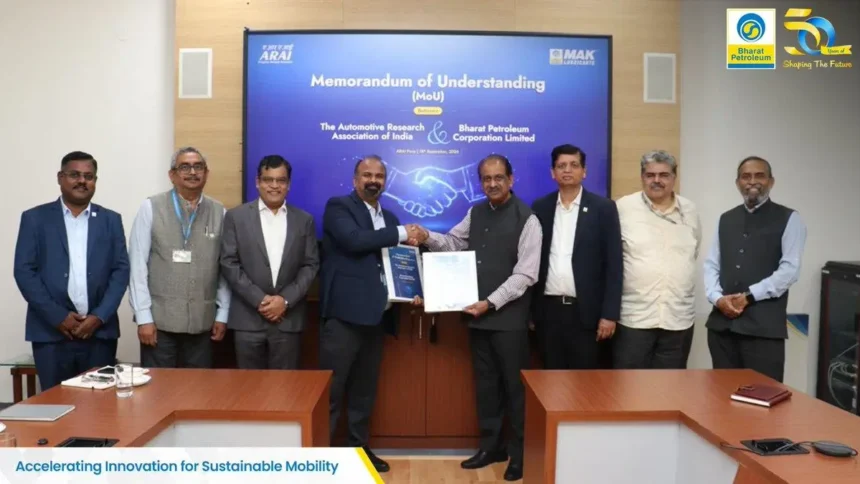
Bharat Petroleum Corporation Ltd (BPCL) and the Automotive Research Association of India (ARAI) are expanding their automotive research collaboration across advanced coolants, lubricants, fuels and additives, bringing together expertise at both ends of India’s mobility transition, from managing heat in increasingly powerful electric vehicles to improving the efficiency and fuel compatibility of conventional vehicles.
The two organisations have signed an MoU that combines ARAI’s testing and research capabilities with BPCL’s expertise in energy and lubrication technologies for joint research, development and testing across advanced lubricants and coolants, next-generation fuels and additives, and automotive technologies. The MoU was exchanged by ARAI Director Dr Reji Mathai and BPCL Business Head (Lubes) Kannan S.
“This collaboration will accelerate innovation, enhance vehicle performance, and shape a cleaner, more sustainable future for the Indian automotive industry,” ARAI said.
EVs turn up the heat
For electric vehicles, the collaboration creates opportunities for the development and validation of advanced thermal-management fluids as charging speeds rise and electric drive systems become increasingly integrated.
One emerging technology is dielectric fluid, which can come into direct contact with battery cells and electrical components. Unlike conventional indirect cooling, where coolant circulates through channels around battery modules, direct or immersion cooling can remove heat closer to the cells, a capability that is becoming increasingly important as high-power fast charging gains traction.
Specialised e-fluids are also becoming critical as electric motors, inverters and reduction gears are packaged into compact drive units. Such fluids must often perform dual functions, cooling electrical components while simultaneously lubricating high-speed gears.
ICE fights for efficiency and E20 stability
For combustion-engine vehicles, advanced low-viscosity lubricants can reduce internal friction and deliver incremental fuel-economy gains as manufacturers face increasingly stringent efficiency and emissions requirements. However, the shift towards lower-viscosity oils requires extensive validation to ensure that efficiency gains do not come at the cost of engine durability.
Fuel additives are another important part of the equation, particularly as India’s petrol pool transitions to higher ethanol-blending levels.
ARAI has undertaken phased validation studies as India moved from E5 to E20 petrol, examining performance, durability, startability and driveability before progressing to vehicle-level and component-material testing using E20 fuel.
“Validating alternative fuel blends is a step-by-step engineering journey built on years of continuous testing and data collection,” ARAI has previously said.
That existing validation base provides a backdrop for the BPCL partnership to focus on next-generation fuels and additives, opening another avenue for the development and testing of new formulations as ethanol use expands, alongside work on fluid technologies for the rapidly growing EV ecosystem, senior company officials said.
Published on September 20, 2026