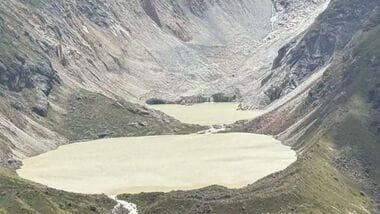
A glacial lake outburst flood (GLOF) reported in northwestern Bhutan has triggered emergency flash-flood warnings across the border in the Indian states of West Bengal and Assam.
According to an NDTV report, prompt evacuations prevented casualties, but disaster management agencies are on high alert along the transboundary Himalayan river systems.
Here’s all you need to know about it:
As the Mo Chhu flows southward out of Bhutan, it joins the Pho Chhu to form the Punatsangchhu, which eventually enters India as the Sankosh River before emptying into the Brahmaputra.
Bhutan immediately alerted Indian authorities about the approaching surge, prompting high alerts in districts bordering the Himalayan nation.
Authorities in Assam’s Dhubri district are closely monitoring water levels, according to an NDTV report.
Meanwhile, flash flood alerts have been sounded in West Bengal’s hills, Alipurduar, and Jalpaiguri districts. In Cooch Behar, the administration has issued specific warnings to residents living along the banks of the Sankosh River.
Urging calm, Amit Kumar Shaw, Superintendent of Police (SP) for the Alipurduar Police District, said: “My appeal to everyone is that there is no need to panic in any way. We are in alert mode, the administration is fully prompt, and all agencies are actively working, so there is no issue. We hope that within two to three hours, we will reach a resolution and address whatever trouble the public is facing.”
A glacial lake outburst flood is the sudden, catastrophic release of a massive volume of water that has pooled in a former glacier bed. As glaciers retreat or thin—a naturally occurring process severely accelerated by human-caused climate change—meltwater forms large, precarious lakes held back only by natural dams of loose rock, ice, and moraine.
When these fragile natural dams fail—triggered by heavy rainfall, landslides, avalanches, earthquakes, or rapid glacial melt—millions of cubic metres of water are violently released downstream, resulting in devastating flash floods that can wipe out infrastructure and communities miles from the source.