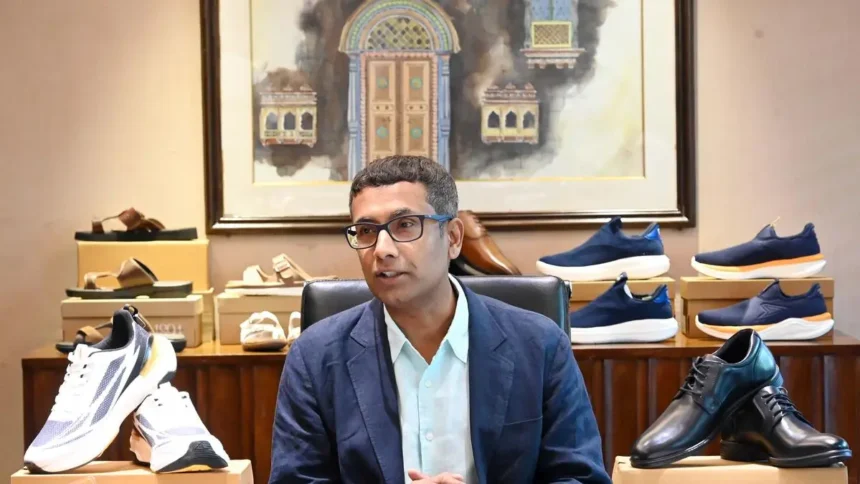
Bata India, the partially-owned Indian subsidiary of footwear giant Bata, is looking to “exponentially increase” the export side of its business.
The expansion comes even as India remains the Switzerland-headquartered footwear giant’s largest market with over 51 million pairs sold in FY26.
In a media interaction, the newly-appointed Managing Director and Chief Executive Officer Sanjay Rao, said that while being strongly entrenched in the domestic market, Bata did not think of India as a major export base. The company exported 50,000 units in FY26, less than 1 per cent of its domestic sales.
“We never thought about it earlier. We were local everywhere and had a large domestic market. But now that we have these competencies in the country that can be globally utilised, we want to do more,” he said. Rao joined Bata India in October of this year
He mentioned that the company has ambitions to grow exports multi-fold by 2030 without sharing a target. Latin America, Africa, South-East Asia and West Asia were highlighted as key potential markets that can be served from India.
Bata’s export goals come at a time when India has emerged as an important player in footwear manufacturing as part of the China plus 1 strategy. Global giants including Adidas, Nike, Puma and Crocs have entered contract manufacturing partnerships in the country.
Rao said that the increasing investment in footwear manufacturing alongside new FTAs will be an additional boost to export opportunities.
Meanwhile, Bata is also looking to grow its domestic business, with plans to double its current topline by 2030. The company reported revenues of ₹862 crore in the quarter ended September 2026, up 8 per cent YoY.
Rao highlighted sneakers as a major strategic priority describing the sneaker market as potentially significantly larger than the traditional brown-and-black formal footwear that the company is most known for in India. Currently, sneakers account for a single digit per cent of the company’s business.
On the distribution side, retail continues to be the backbone of the business with around 2,000 stores in the country, while e-commerce and quick commerce accounts for about 10 per cent of business.
Published on November 19, 2026