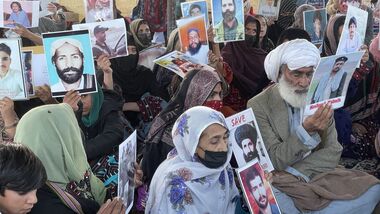
The killing of a schoolteacher in Pakistan’s Balochistan province has triggered fresh protests, with residents and rights activists accusing authorities of shielding those responsible and demanding accountability over alleged state-backed armed groups and enforced disappearances.
Family members and residents staged a demonstration outside the Pasni Press Club following the death of Parvez Mazar, an Arabic teacher at Government High School Babbar Shor.
Protesters demanded the immediate arrest of the suspects and warned that they would block the strategically important Makran Coastal Highway if the authorities failed to act, according to an ANI report citing The Balochistan Post.
The demonstration comes amid continuing protests by families of missing persons in , where allegations of enforced disappearances, torture and extrajudicial killings have fuelled longstanding anger over human rights and accountability.
According to The Balochistan Post, Mazar was found dead in Pasni a day after he was allegedly taken away in front of his family.
Relatives alleged that members of an armed group, which they described as a state-backed “death squad”, abducted the teacher and took him to a private facility where he was allegedly tortured and killed.
Protesters alleged that individuals named in the first information report (FIR) were being protected by and called for the suspects to be handed over to the police for legal proceedings, as per ANI.
Addressing the gathering, demonstrators urged state institutions to act against armed groups accused of abducting, torturing and killing civilians while allegedly operating under the protection of state agencies, The Balochistan Post reported.
The term “death squads” is frequently used by Baloch rights organisations and activists to describe armed groups they allege receive support or protection from Pakistani state institutions.
These groups have been accused of targeting civilians, political activists and human rights defenders in Balochistan.
Rights campaigners have repeatedly raised concerns over alleged links between such groups and security agencies, particularly in cases involving abductions and killings.
The allegations form part of a wider human rights crisis in the province.
Pakistani authorities have faced sustained criticism from local activists and international human rights organisations over allegations of abuses by security personnel.
The competing allegations and lack of accountability in individual cases have deepened mistrust between sections of the local population and the state.
Mazar’s killing comes as families of missing persons continue a prolonged sit-in outside the Press Club, demanding information about relatives who they allege were forcibly disappeared.
The Voice for Missing Persons (VBMP) said a government commission had formally registered another disappearance case, according to The Balochistan Post, as cited by ANI.
Among those who joined the demonstration were the father and brother of Kamran Khan, who was allegedly detained by security forces from Killi Kashmirabad on Qambrani Road in Quetta on April 1 and taken to an undisclosed location.
His family said the prolonged uncertainty over his whereabouts had caused severe psychological distress.
The protest camp also received Khan Muhammad, whose son, Muhammad Riaz Satakzai, was allegedly forcibly disappeared from the Frontier Corps checkpoint at Daghari Cross on May 6, says report.
Khan Muhammad said police and senior officials had recorded his statements following instructions from the commission, but the family had received no explanation for the alleged detention or information about his son’s whereabouts.
Nasrullah Baloch urged authorities to recover Kamran, Riaz and other missing persons.
Enforced disappearances have remained one of the most persistent human rights concerns in Balochistan.
Activists and families accuse and intelligence agencies of detaining students, activists, academics and journalists suspected of dissent or links to separatist movements, often without disclosing their whereabouts.
Families of missing people have repeatedly demanded that authorities either produce their relatives before a court or provide credible information about their fate.
Human rights organisations, including Human Rights Watch, and experts have raised concerns over alleged abuses and the need for accountability in Pakistan.
With inputs from ANI.