



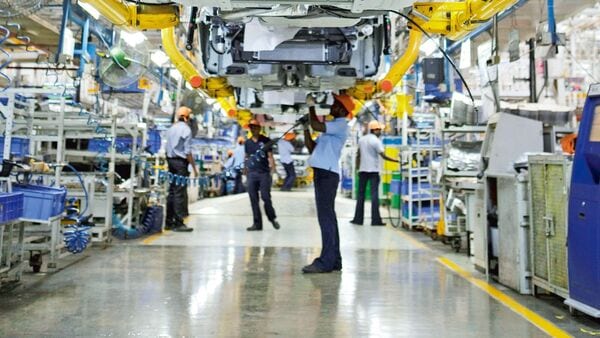
New Delhi: At least half a dozen auto and component companies are investing in captive renewable energy projects that give them direct access to green power, seeking to lower electricity costs while increasing the use of clean energy to meet their decarbonisation targets.
Tata Motors Ltd, ‘s Swaraj Tractors, Escorts Kubota, Maruti Suzuki, Samvardhana Motherson and SPR Auto Technologies are among companies developing, commissioning or investing in renewable energy projects linked to their manufacturing operations, according to their filings and announcements in the current financial year.
The shift towards captive and group-captive renewable power reflects a dual objective: reducing companies’ exposure to electricity costs while cutting emissions from manufacturing. The move comes as the share of renewable power in companies’ electricity consumption reaches an all-time high, with captive projects offering potential power-cost savings of about 10-40%, depending on the state, according to experts.
“Captive solar enables manufacturers to secure a portion of their electricity requirements at a more predictable long-term cost, reduce exposure to grid tariff volatility and lower Scope 2 emissions,” said Alekhya Datta, director, electricity and renewables Division, The Energy and Resources Institute (TERI).
“Compared with external renewable procurement through open access, captive generation can provide greater control over the source and cost of electricity, although it may involve higher upfront investment and project-development responsibilities,” Datta said.
The push for captive green-power projects also comes as the government nudges manufacturers to increase the use of electricity in the production of parts and vehicles, following disruptions to natural-gas supplies during the West Asia war.
A review of companies’ latest annual reports bears out the trend. At Mahindra & Mahindra, renewable electricity accounted for 37% of consumption in FY26, up from about 30% in FY25.
‘ commercial-vehicle business sourced 181 million kWh of renewable electricity in FY26, accounting for 51% of its total power consumption, up from 47% in FY25. At Maruti Suzuki, the share of electricity from renewable sources rose to 22.8% in FY26 from 21.3% in FY25.
In July, Tata Motors partnered with Welspun Renewable Energy to co-develop an 86 MW wind-solar hybrid project that will supply renewable power exclusively to four of its manufacturing plants in Jharkhand, Uttar Pradesh, Uttarakhand and Karnataka. The project is expected to generate about 200 million units of electricity a year.
In response to queries from Mint, SJR Kutty, chief sustainability officer at Tata Motors, said that as manufacturing processes become increasingly electrified, the emissions profile of the firm’s operations is increasingly influenced by the carbon intensity of the electricity consumed.
“Expanding the share of renewable power is therefore fundamental to delivering meaningful emissions reductions across our manufacturing footprint,” said Kutty.
“Captive and group captive renewable energy projects typically offer higher savings through regulatory benefits such as subsidies and waivers. Compared with OPEX-based renewable power purchase agreements, the additional savings can typically range from approximately ₹1.5 to ₹3 per kWh. Savings are often significantly higher when compared to green tariff offerings from DISCOMs,” said Kutty.
Similarly, in September, Swaraj Tractors, the tractor arm of Mahindra & Mahindra, commissioned a 42 MWp solar project in Bathinda, Punjab, with group company Mahindra Susten. The project will supply power to Swaraj’s manufacturing, assembly and foundry operations in Mohali and is expected to meet about half of their electricity requirements.
, the country’s largest carmaker, commissioned a solar captive plant last year and installed a 1 MWh battery energy storage system at its Kharkhoda plant in Haryana in July this year.
According to the company, the system will store electricity generated from the plant’s renewable energy sources and allow the carmaker to use it when required, helping increase the share of renewable power in its manufacturing operations.
“We have aligned our business priorities with the national goal of achieving net-zero. By deploying multiple clean technologies, we aspire to reduce carbon footprint in manufacturing operations from the present 615,000 tonnes per year to 266,000 tonnes per year in FY 2030-31. We have earmarked about INR 1,000 crore towards green energy initiatives by FY31,” said Rahul Bharti, senior executive officer of corporate affairs at Maruti Suzuki, in response to Mint’s queries.
Samvardhana Motherson commissioned a 15 MWp solar project in June in Mahoba, Uttar Pradesh, through its energy arm Motherson New Energy. The project will supply renewable electricity to multiple Motherson manufacturing plants in the state and is expected to generate about 23.4 million units of electricity annually.
Some companies are also investing in projects, either directly or through newly incorporated entities, to secure access to clean power.
Tractor maker Escorts Kubota approved the formation of a joint venture with renewable energy company Ampin Energy Transition in August to develop a solar power project for its own electricity requirements. Escorts Kubota will hold a 26% stake in the project company and has committed up to ₹3.8 crore towards the venture.
Mahindra & Mahindra said in its annual report that it had also moved to secure more renewable power for the current financial year.
“The target for increasing the share of renewable energy to around 50% was set for FY27. In tune to that target, the Company has signed long term RE Captive/ Group Captive agreements with RE generator for Punjab, Maharashtra and Tamil Nadu which will take the Company to more than 50% Renewable Energy by FY27,” Mahindra’s latest annual report said.
Auto component maker SPR Auto Technologies, formerly Shriram Pistons and Rings, invested in a solar power project being developed by Sunsure Energy in August. The company committed up to ₹6 crore and agreed to buy electricity generated by the project for its manufacturing facility in Pathredi, Rajasthan.
“For component manufacturers, this is becoming particularly important. Global automotive customers are increasingly looking at the carbon footprint of their supply chains. Demonstrating that products are manufactured using renewable energy will increasingly become important for winning export business, and remaining part of global supply chains,” said Vinay Piparsania, founder at Millenstrat Advisory and Research.