



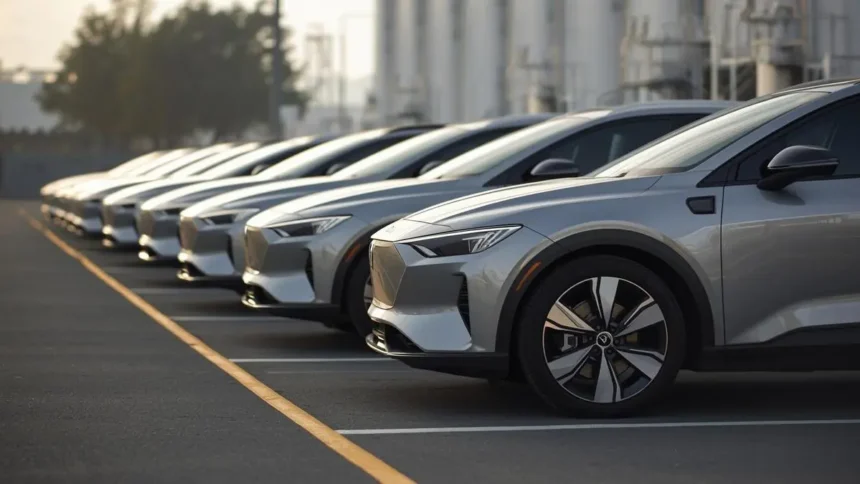
India’s automakers are crowding the festive season with new products, powertrains and ownership options, intensifying the fight for consumers just as vehicle demand accelerates. Maruti Suzuki is introducing automatic transmissions in three CNG models, Kia has entered the factory-fitted CNG segment, Tata Motors has expanded the Sierra lineup, Hyundai is preparing to launch the Bayon, and JSW MG Motor has extended its Battery-as-a-Service offering to the Cyberster and M9.
The offensive extends to two-wheelers, where TVS Motor has refreshed its premium motorcycle range and Royal Enfield is taking its Flying Flea electric motorcycle to Europe. Automakers are chasing stronger festive volumes while contending with a higher base, elevated commodity and freight costs, and heavier discounting. At the same time, they remain cautious on production and are prioritising higher-specification models to protect margins. Passenger vehicle wholesales surged 36.5 per cent in August, while two-wheelers grew 10.5 per cent, three-wheelers 22.8 per cent, and commercial vehicles 30.7 per cent, according to SIAM data.
And the launch cycle is far from over. Mahindra & Mahindra will unveil the refreshed three-door Thar on September 22, while JSW GreenTech is preparing to launch heavy electric trucks and buses, taking on incumbents such as Tata Motors and Ashok Leyland. From cars and motorcycles to electric scooters and heavy trucks, virtually every major segment of India’s auto market is joining the festive-season battle.
Passenger vehicle volumes hit an August record of 4,39,309 units. Retail registrations rose a comparatively slower 16.14 per cent to 4,02,398 units, while rural registrations climbed 24.99 per cent, outpacing the 10.93 per cent growth recorded in urban markets. Former FADA Chairman Vinkesh Gulati said rural demand is outperforming urban centres, while CNG vehicles, hybrids and EVs are accounting for a larger share of early festive bookings. Dealers, however, entered the season with passenger vehicle inventory estimated at 38-40 days.
Honda Cars India is investing ₹450 crore to expand its Bengaluru spare-parts warehouse to 140,000 sq. m., supporting its car, two-wheeler and power-products businesses.
“The expanded facility will enable faster availability of genuine spare parts and further strengthen our after-sales support,” said Honda Cars India CEO Takashi Nakajima.
Maruti’s automatic CNG variants of the Swift, Dzire and Baleno underscore how finely the market is being segmented. Tata Motors pioneered factory-fitted CNG automatics with the Tiago and Tigor before extending the technology to the Punch. Maruti is now responding across three of its highest-volume models.
Maruti recorded its highest-ever monthly S-CNG sales of about 83,000 units. “During the first quarter of this year, we experienced a 58 per cent increase in sales compared with the same quarter last year for our S-CNG vehicles,” said Partho Banerjee, Senior Executive Officer, Marketing & Sales, Maruti Suzuki.
Kia is adding CNG options to the Carens and Carens Clavis while introducing automatic transmissions in more affordable variants.
“CNG continues to be an important consideration for a growing set of customers seeking an efficient and practical mobility solution,” said Atul Sood, Senior Vice President, Kia India.
“The competitive battleground is increasingly centred on the same customer,” said Avik Chattopadhyay, Founder of Expereal, pointing to the growing mix of fuel options, transmissions and body styles available to buyers.
TVS Motor has refreshed its Apache and Ronin ranges, adding features, variants and special editions across models ranging from the RTR 160 to the RR 310. The upgrades include traction control, connected features and suspension enhancements, along with Black Diamond editions of the RR 310 and RTR 310. The Ronin also receives additional safety and connectivity features.
Electric scooters and motorcycles represent another growth frontier, with Royal Enfield taking the electric contest overseas. Deliveries of the Flying Flea C6 will begin in Europe and the UK in October after early users logged more than 100,000 km in India within three months.
“The response has been outstanding,” said Eicher Motors Managing Director and Royal Enfield CEO B. Govindarajan.
Light commercial vehicle retail sales rose 21.3 per cent in August, while medium and heavy commercial vehicle sales increased 18.2 per cent, supported by demand from infrastructure, mining and logistics.
Cost pressures, however, remain. Tata Motors will raise commercial vehicle prices by up to 1 per cent from October 1.
JSW GreenTech is meanwhile preparing to enter a market dominated by Tata Motors, Ashok Leyland and VE Commercial Vehicles with an ARAI-approved 12-metre electric bus and heavy electric truck platforms.
Its proposed facility in Chhatrapati Sambhajinagar is planned with annual capacity of 10,000 electric buses and 5,000 electric trucks. The group’s steel, mining and energy businesses could also provide a captive customer base and a real-world testing ground for its commercial EV products.
Published on September 20, 2026