



Also by Sarasvati Thuppadolla
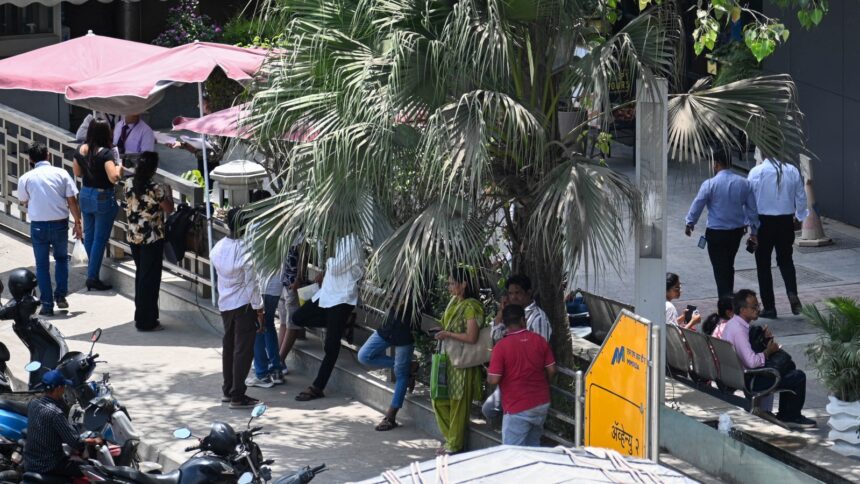
Outside VFS Global House on ’s KG Marg, the sun bounces off glass facades and onto the crowd under the shade of a bunch of trees. A few hundred metres away at the Shivaji Stadium metro station, another restless line of people clutch plastic folders.
Welcome to the two VFS Global centres in the national capital, where the anxiety is palpable — not just about but also the “extra” money that, said, they were asked to pay for services they didn’t know was optional.
At these two centres, nearly half of the 85 applicants this newspaper spoke to complained of being “pushed towards” value added services: premium lounge, SMS alerts and courier fees. Two-thirds of over 60 applicants outside VFS Global’s Bandra-Kurla Complex centre in spoke about the same pressure.
It’s not just applicants. Several current and former they had to push premium services to meet “sales targets,” even sometimes leading applicants to believe that this would “improve their chances” at the visa centre.
They echo concerns that European monitors have zeroed in on, a refrain in inspection records of centres in 20 countries obtained by Lighthouse Reports, a non-profit investigative newsroom based in Utrecht, The Netherlands. These were collaboratively investigated by media organisations in 11 countries, including The Indian Express in India.
These records flagged a range of concerns — from how applicants’ data is stored on unencrypted discs to “lapses” in informing applicants that value-added services (VAS) are optional and have no link to visa approval.
Responding to the investigation, VFS Global said its services are transparent, tightly audited and “subject to rigorous and continuous government oversight”.
In India, Records of Registrar of Companies (RoC) show VAS grew from 6.3% (Rs 25.7 crore) of the company’s Rs 408 crore revenue in FY 2015-16 to 17% (Rs 114.7 crore) of Rs 673 crore in FY 2019-20. Between 2016 and 2024, profits rose 20-fold — from Rs 7.7 crore to Rs 155 crore — as revenue climbed from Rs 411 crore to Rs 1,125 crore.
The company’s consolidated accounts in Luxembourg consistently attribute the firm’s growth to sales of VAS. Its operating profits have increased four-fold since 2017, reaching 172 million euros in 2024. Over the same period, records show, the company processed just 15% more visas.
The company stopped reporting VAS revenue separately from FY 2020-21, and started sharing break-up of revenue under segments. Yet, a sample of around 2,000 receipts for Swedish visa applications across 16 countries from a two-week period last year — obtained by Lighthouse Reports through a Freedom of Information (FOI) request — shows VAS accounting for over 30% of revenue.
In the India sample, this was largely driven by premium lounge services, with a 17% take-up rate contributing 21% of VFS revenue. Courier fees were used by 55% of applicants, contributing 12%, while SMS services had a 46% take-up rate, contributing 6%.
Responding to queries on VAS and employees pushing these services, VFS Global said applicants are “clearly informed” online and at visa application centres that they are “optional, do not influence visa decisions or processing times, and are priced transparently”. “The pricing is government-approved and benchmarked. VFS Global maintains a zero-tolerance approach to any coercion or misrepresentation,” it said.
On financial reporting, it said “changes in reporting format are the result of the transition to Indian Accounting Standards…which require companies to report financial data based on operational segments rather than specific product lines”.
Speaking to The Indian Express, a 26-year-old, who was among a group of three men waiting outside the Shivaji Metro Station centre in Delhi for a visa to Bulgaria for work, said: “They took over Rs 3,000 as premium lounge fees…They said you can’t enter without this.”
The Indian Express reviewed his visa receipt: courier assurance Rs 1,260; premium lounge Rs 3,360; SMS fees Rs 420; interview fees Rs 1,575. Of a total bill of Rs 15,000, roughly a third, about Rs 5,000, went to VAS.
Outside the KG Marg centre, a 35-year-old man from Punjab waiting for his London visa describes the sales pitch. “Sometimes they just tell people to go in a different line. Earlier, they wouldn’t even spell out clearly that the fees will be higher. Taking premium services should feel voluntary,” he said.
Another applicant for a German student visa from Punjab claims that she was “led to believe” it is mandatory for students applying for a German visa to go through the premium lounge. “I paid around Rs 2,800 that time. I know many fellow student visa applicants who faced the same issue,” she says.
According to former employees of VFS Delhi, staff members are trained to pitch and push applicants to opt for VAS, and the company encourages the sale of optional services by linking it to the staff’s performance-linked incentive structure.
“We had targets on SMS and courier,” said an ex-employee who left the company in 2017. “We had to pitch, try to convince even if the applicant said no. People think that we are from the embassy and whatever we are saying is right, especially those visiting for the first time. We hardly got any denials.” During his tenure, he said, employees had monthly targets to pitch VAS for which they would earn at least Rs 100 on every combination of SMS and Courier sold.
A current VFS Delhi employee, who has been working with the company for four years in the Schengen unit, said there is an incentives system linked to the sale of value added services. While employees are not informed of the exact percentage distribution of the amount earned from these sales, he said that on average he earns around Rs 7,000 to Rs 8,000 every month as incentives.
At the VFS Global centre in Mumbai, the same pattern plays out. A 27-year-old applying for an Italy visa watched his bill climb from Rs 9,000 to Rs 15,000. “They kept adding things like SMS, courier, and then the lounge. At that moment, you are already nervous about your documents and timelines, so when they say it will make things faster, you just agree,” he said. Having taken leave from college, he said, “I didn’t want to take any chance and come here again, so I just paid whatever they suggested.”
A 35-year-old applying for a Canada visa found no advantage to what he had paid for. “My total came to around Rs 13,500. They kept adding things step by step, first SMS, then courier, then lounge, saying it will be faster. But there is no separate priority lane inside. Everyone still goes through the same counters and the same token system,” he said.
A 30-year-old IT professional applying for a Norway visa paid nearly Rs 18,000 in total, including Rs 3,500 for the lounge and around Rs 4,000 combined for courier and SMS. “Once I was inside, there was no difference in processing time. I was still called based on the same queue as everyone else. They give you the impression that premium means faster movement, but in reality, it’s just a different seating area,” he said.
A 35-year-old, heading to Germany on a tourist visa, replays the pressure that many describe. “It was technically called optional, but it was said in a way that made it feel like if I opted for these services, my process would be faster and there would be less chance of rejection or delays. I didn’t actually want to spend on any of this, but I also didn’t want to risk complications after going through the entire application process. So I ended up paying, even though it clearly felt unnecessary and more like pressure than value,” he said.
With Sarasvati Thuppadolla, investigative reporter at lighthouse reports

