



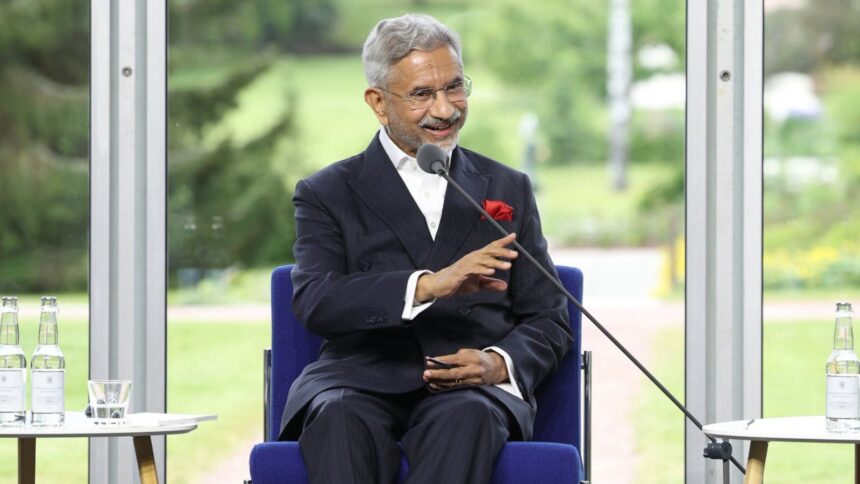
External Affairs Minister S Jaishankar on Thursday took aim at what he described as the United States’ inconsistent approach towards India’s purchase of Russian oil. He said Washington had, at one point, encouraged New Delhi to buy Russian crude to stabilise global energy markets, only to later
Speaking at the “Emerging Powers and the New Geopolitical Competition” session at the Kultaranta Talks in Finland, Jaishankar said, “Let’s not pretend that there is some great principle involved here. I mean, if it is on-off, on-off, and the US wants to do it when it suits them and not do it when it doesn’t suit them.”
The remarks came in response to a question on New ’s position on the Russia-Ukraine conflict, with a journalist accusing the India of being “too sympathetic to Russia” and “too willing to buy oil from Russia”.
Participated in a Panel discussion at Kultaranta Talks with FM Elina Valtonen of Finland, and Assistant FM Lana Nusseibeh of UAE on ‘Emerging Powers and the New Geopolitical Competition
— Dr. S. Jaishankar (@DrSJaishankar)
Defending New Delhi’s energy choices, Jaishankar outlined India’s realistic approach to safeguarding its national interests. “I’ll make two observations. I buy oil based on cost and availability. So at that point, much of the oil on the market was Russian because Europeans were essentially buying oil from the Middle East, our traditional supplier. So circumstances pushed us in a certain direction,” he said.
Jaishankar recalled that in 2022, Washington itself recognised the vital role India played in maintaining global economic equilibrium. According to him, the United States had encouraged New Delhi to procure Russian crude to stabilise energy markets and prevent a sharp rise in global inflation following Western sanctions on Moscow.
“At that time, the US directly asked India to buy Russian oil to stabilise the oil market. We buy oil based on cost and availability,” he maintained during his address in Finland.
The External Affairs Minister also questioned the contradictions in Western sanctions policies, cautioning against applying a selective moral lens to complex issues in global trade and energy security.
While also addressing Europe’s historical and moral inconsistencies on global security issues, Jaishankar noted that no European country has ever been attacked with Indian weapons.
“I wish I could say that for European weapons vis-à-vis India,” he remarked, underscoring India’s peaceful global record.
When asked to elaborate, the minister reiterated New Delhi’s long-standing concerns over Western arms supplies to the region.
“Europe sells weapons that are used to attack India. Not just now, but for many years. We Indians have never done anything to endanger Europe. I think that’s a reasonable point,” he said.
Jaishankar’s forceful defence of India’s sovereign policy choices was the latest in a series of candid diplomatic interventions during his engagements across Europe, where he has consistently pushed back against what New Delhi sees as double standards in the West’s approach to global security, energy policy and strategic autonomy.

