



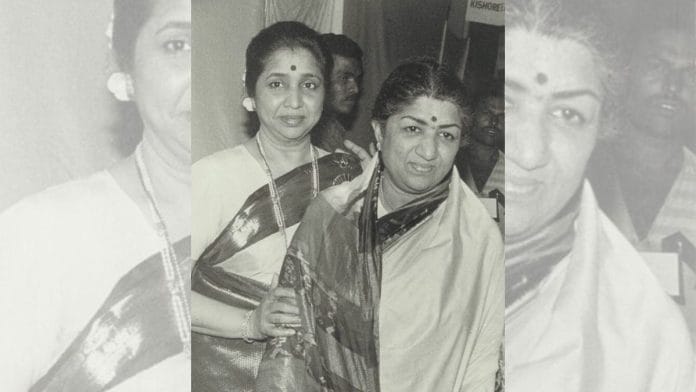
So, her ‘Western-suited voice’ was what gave Bhosle a toehold in the ledge crowded with the firmly planted feet of her elder sister Mangeshkar, Geeta Dutt, and Shamshad Begum. Inevitably, the cabaret genre became one of Bhosle’s identifiers, with stalwarts such as Shankar-Jaikishan using her as the voice of Helen in the raunchy ‘Itni Badi Mehfil’ from Dil Apna aur Preet Parayi (1960). By the early 1960s, Dutt’s career started crumbling due to personal problems, leaving the field open for the two sisters.
The bifurcation between Bhosle and Mangeshkar was not about classical vs cabaret or good girl vs bad girl. It was about the tonal quality and the style of singing suited for a specific sequence. Consider the Asha-Kishore duet ‘Chhod Do Aanchal’ from Paying Guest (1957). The sequence was set in a flower garden, miles away from any cabaret joint. The girl’s bashfulness was not even remotely relatable to a bar dancer.
“Asa (that was how SD Burman pronounced her name), if your lover were to tug at your sari, how would you react?” the composer asked her to get the perfect ‘aah’ exclamation. And Bhosle delivered just that, making it arguably the first Hindi song to begin with an exclamation.
In the same film, it was Mangeshkar rendering the soulful ‘Chand Phir Nikla’.
Another example is that of Nasir Hussain’s films, starting with Dil Deke Dekho (1959). It was lead actor Asha Parekh’s character that decided whether Bhosle would be the lead playback singer. Wherever Parekh played a modern girl in Western attire and was comfortable socialising in clubs, it was Bhosle. But when Parekh’s characters were diametrically opposite in Baharon ke Sapne and Pyar ka Mausam, the spot went to Mangeshkar.
For similar reasons, ‘Dum Maro Dum’ in Hare Rama Hare Krishna (1971) belonged to Bhosle not because Zeenat Aman played a ‘bad girl’. It was because the on-screen hippies were high on inexpensive grass and free love, and so the voice needed to be sultry.
Ramesh Iyer, RD Burman’s lead guitarist, once made a sharp observation. “Ashaji’s laughter blends so easily into the mood of the song,” he said. See how well RD Burman used this specific feature of her voice in the electrifying ‘Mera Naam Hai Shabnam’ from Kati Patang (1970). Bhosle’s taunting laughter in the lyrics was the dancer Shabnam (Bindu) winking at Madhu (Parekh), threatening to unmask the impostor.
On the other hand, composer Roshan scored three qawwalis in the musical Barsaat Ki Raat (1960), all of them in a muqabla (competition) format. ‘Nigah-E-Naaz Ke’ and ‘Pachanatha Hoon Khoob Tumharee Nazar Ko Mein’ propped up the parallel romcom story track in what was otherwise a tragic love story. And then there was the pathos-tinged finale ‘Na To Karvan Ki Talash Hai’ in the climax scene. Bhosle was one of the two female lead singers in all the three qawwallis. Her non-film albums such as also bear out this point.
OP Nayyar used Bhosle end-to-end, starting in the late 1950s, so it is hard to discern a differentiation in the choice of singers for his music based on the situation.
As the queen of melody travels to another world, let us continue to unravel the truth underneath many such perceptions. The discovery has just begun.
(Edited by Prasanna Bachchhav)

