



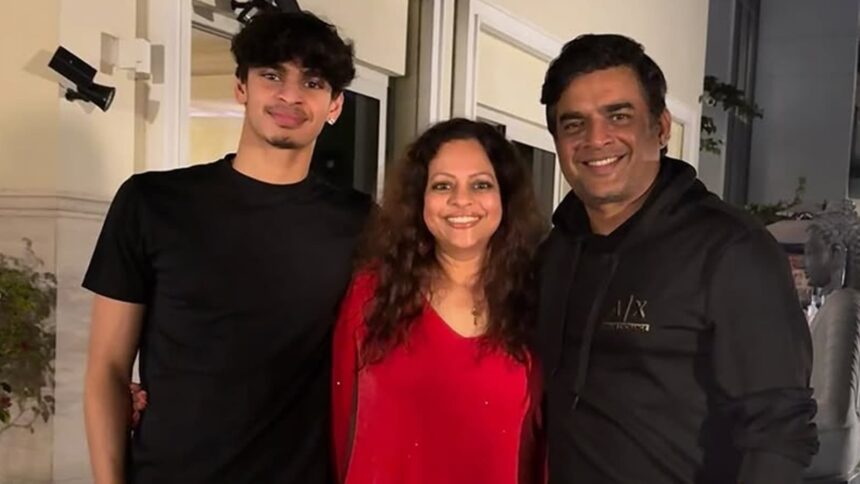
Actor R Madhavan has often spoken about raising his son, freestyle swimmer Vedaant Madhavan, with discipline, gratitude, and humility despite growing up in a financially privileged environment. In a recent conversation on the 100 Year Life Project by ACKO with Radhika Gupta, Madhavan reflected on the that shaped his son’s upbringing.
Speaking about teaching respect and awareness of privilege, Madhavan said, “The thing I made sure that Vedaant did was to acknowledge, maybe not as much as my friends, but most certainly acknowledge the liftman, the guard, the drivers, you know, and not call them aayas and stuff like that. Call them didis instead. And I made sure that if the watchman came and said, ‘You are a very polite child, he always says namaste to me,’ I thought my job was well done.” His comments highlight how many parents today are trying to ensure children grow up with empathy, social awareness, and respect for people across all professions, especially in homes where domestic help and support staff are a part of everyday life.
Madhavan also opened up about a parenting lesson he learned while living in Canada years ago. He recalled staying in a town where issues like teenage pregnancy, drugs, and alcohol were common among young people. However, one particular family stood out to him because their and grounded despite the surrounding environment. Curious about how they managed it, Madhavan said he later asked the mother for advice, and her response stayed with him for years.
Recalling the conversation, he said, “I happened to ask the lady of the household many years later, I said, ‘How did you manage to do this?’ And she gave me an advice which I followed to the heart, and it really worked for my son. And she said, ‘Don’t give your child free time. She said, ‘You know, indulge him or her in whatever they want to do, as long as they’re doing it with passion. The interests will change, the level of commitment will change, but make sure that they don’t have free time till they’re 15-16 years old. Make it a habit to make sure they go from one activity to another. And it could be fun. It should be fun. It shouldn’t be a chore, the child is going to hate it’.”
Dr Sakshi Mandhyan, psychologist and founder of Mandhyan Care, tells indianexpress.com, “Free time is not wasted time for children. In my observation, unstructured time plays a key role in emotional development, creativity, nervous system recovery, and most importantly, independent thinking. Children do need moments wherein they are not constantly performing or being evaluated. This mental pause helps the brain handle emotions and experiences in a more natural way.”
At the same time, she states, children also benefit from structure and rhythm. Completely unstructured days can sometimes increase restlessness or . Developmentally, the healthiest balance usually includes activity, responsibility, social interaction, and downtime.
Activities like sports, music, creative pursuits or hobbies are valuable because they teach consistency, emotional regulation, patience, and the ability to handle setbacks. Dr Mandhyan stresses, “But children also need room to breathe within those routines. I regularly see or hear about emotionally exhausted children who appear highly productive on the outside.”
Parents sometimes focus so much on building potential that they miss the child’s emotional state. A tired child may not always say “I am overwhelmed” or “I don’t feel like doing this.” It may show up as irritability, withdrawal, or even resistance. “I encourage parents to stay emotionally connected to the child, not only to the schedule. Children grow best when encouragement is supportive and not constantly evaluative,” says Dr Mandhyan.

