The Supreme Court on Monday refused to hear a plea raising concerns over exorbitant prices charged by airlines during festivals, saying, ‘Don’t travel by air.’ The application mentioned before a bench of Justice Vikram Nath, Justice Sandeep Mehta and Justice Aparesh Singh stated that the petition was listed for hearing on November 16, by which major festivals, including Diwali and Chhath Puja, would be over. Hence, the applicant pressed the matter for urgent listing.
“The aviation fare has increased by 700 per cent,” the advocate said.
Justice Nath told the advocate representing the applicant, “Don’t travel by air”, before moving on to the next case.
S Laxminarayanan, a social activist, had filed a petition in the top court last year, asserting that airlines charge high fares around festival seasons.
While hearing the matter in January this year, the top court termed the high fares charged by airlines “exploitation” and said: “We will definitely interfere. Just see the exploitation during Kumbh and other festivals. Just see fares from Delhi to Prayagraj and Jodhpur – three times the normal.”
During the May 15 hearing, a bench comprising Justice Vikram Nath and Justice Sandeep Mehta told the government that airline ticket prices needed to be rationalised.
Solicitor General Tushar Mehta, appearing for the Centre and the Directorate General of Civil Aviation (DGCA), informed the court that the government was working on framing rules under the new Bharatiya Vayuyan Adhiniyam, 2024. However, the bench emphasised the need for immediate relief for passengers.
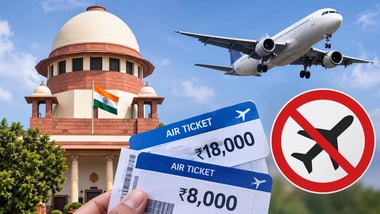
“Try to give some relief to people… on the same day, flights to the same sector… one airline charges ₹8,000, another airline charges ₹18,000 for the economy class,” the bench observed.
In his latest application, Laxminarayanan also cited media reports highlighting how airfares on several major domestic routes had already surged to between two and seven times their usual levels.
Airlines attributed the rising fares to increasing Aviation Turbine Fuel (ATF) prices, which impacted their operational costs. The application argued that while such factors may warrant a slight increase in ticket prices, they cannot justify fares rising to seven times the normal rate.
The advocate said air transport is an essential service and called it a “violation of Article 14”.
Article 14 of the Constitution deals with equality before the law.
“No other essential service is priced in this manner. The Railways’ flexi-fare is capped at one-and-a-half times the base fare, prices of essential medicines are capped under the Drugs (Prices Control) Order, 2013, electricity tariffs are fixed by regulatory commissions.”
“Air travel cannot be the sole exception,” he added.
The applicant also pointed out that ‘air transport is an essential service under the Essential Services Maintenance Act, 1981’, and said: “A service the State treats as essential for securing its continuity cannot be left wholly unregulated as to its price, to the prejudice of the very public it serves.”