


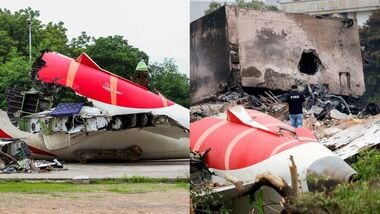
More than a year has passed since the tragic Flight 171 crashed shortly after takeoff on 12 June 2025 in Ahmedabad, killing at least 260 people, including all but one aboard, and the Aircraft Accident Investigation Bureau (AAIB) is yet to finalise its probe report.
On Friday, the Federation of Indian Pilots () wrote a letter to the Civil Aviation Ministry, asking it to ensure that its technical submissions on the plane crash are formally considered before the probe report is finalised, ANI reported, adding that the AAIB’s investigation into the AI 171 crash is at an advanced stage.
Writing a letter to Civil Aviation Minister Rammohan Naidu, FIP urged that the group be nominated as an “independent technical participant in the review of the draft AI171 final investigation report”. Further, the FIP said that it is now “reliably learnt that the government/ ministry has directed or is considering requiring the draft report to undergo examination by an independent committee before it is circulated/ finalised.”
It also said that any review should include a perspective from a professional pilot and added, “An independent review which does not include an appropriate professional pilot perspective would leave an important technical dimension insufficiently represented.” The FIP further stated that a “transparent and technically independent review” that includes “meaningful representation of the Professional Pilot community” would align with the broader objective of enhancing aviation safety in India.
Against this backdrop, the body representing commercial pilots stated that if an independent review mechanism is established, it should be formally included in the process as an independent technical stakeholder representing the professional pilot community.
According to media reports, the FIP has earlier pointed to what it describes as inconsistencies between the AAIB’s preliminary report and independent simulator assessments, especially regarding the timing of the Ram Air Turbine (RAT) deployment and the availability of hydraulic power. The RAT is a small propeller-driven generator that deploys from the to provide emergency power when the engines fail.
The FIP flagged discrepancies after the initial AAIB report revealed that the interruption in the fuel system took place around 1:38 pm, with the RAT starting to supply hydraulic power roughly four seconds later. According to the FIP, simulator testing revealed that RAT-generated power became available only around 18 seconds after a fuel-system interruption. The federation has also raised questions over variations in take-off performance timings between the preliminary report and simulator tests.
Last week, the pilots’ body asked India’s aviation accident investigation body to conduct a comprehensive evaluation of electrical system evidence related to aircraft during its detailed investigation into the AI 171 crash. In a letter to the Director General of the AAIB, the FIP wrote, “As you are aware, the Boeing 787 is one of the most electrically dependent Commercial Aircraft ever produced. Numerous systems traditionally powered by pneumatic or hydraulic means have been replaced by electrically driven systems. Consequently, the reliability, integrity, and interaction of electrical generation, distribution, monitoring, flight-control, avionics, data-network, and aircraft management systems are central to the safe operation of the aircraft.”
Air India’s Boeing 787-8 Dreamliner, registered as VT-ANB, crashed shortly after taking off from Ahmedabad for London Gatwick on 12 June 2025, killing 241 people onboard and 19 people on the ground. One passenger survived, while all 12 crew members were killed in the crash during the initial climb. Among the passengers who died were citizens from India, the UK, Portugal, and Canada.
(with ANI inputs)