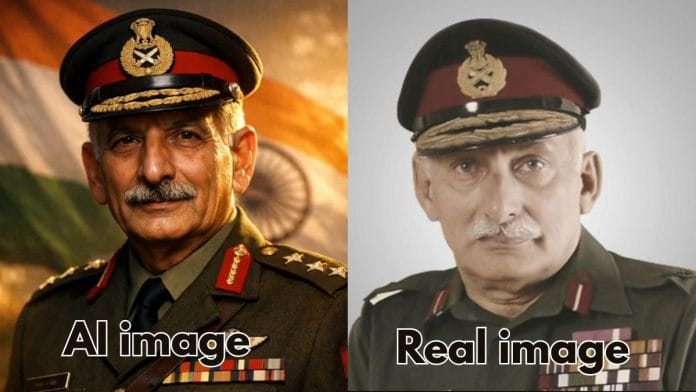
The surge in AI-generated imagery on pages dedicated to India’s military heroes, military history and defence training academies is accelerating faster than most people realise—and the implications go far beyond aesthetics or creative licence. They cut to the integrity of memory itself.
Photographs of soldiers who fell in 1947, in 1962, in 1965, in 1971 are not easy to come by. Many exist as a single image: A formal portrait, a regimental photograph, a grainy print preserved by a family for decades. Some have no surviving photographs at all. This scarcity is not a gap to be filled. It is itself part of the historical record.
Into this scarcity, AI inserts abundance. Faces sharpened. Uniforms perfected. Medals rendered with cinematic precision. And a generation raised on high-resolution screens encounters these fabrications not as illustrations, but as fact. This is how history begins to shift.
As the founder of Lest We Forget India, a platform dedicated to preserving the memory of our fallen soldiers and chronicling military history, I have spent years understanding how fragile this memory is. That responsibility is the entire point. Which is why what is now entering these spaces demands to be named plainly.
Cinema has always interpreted history—compressing, dramatising, omitting—and audiences understand that contract. But remembrance pages and archival platforms operate differently. They are expected to preserve, not interpret. When AI-generated imagery enters these spaces without disclosure, it is distortion.
Military history must be precise. Every detail carries meaning. A medal grouping reflects campaigns and honours earned. A uniform’s insignia situates a soldier within a specific regiment, rank, and era. AI gets these details wrong—often subtly, but consistently. A medal that was never awarded. An insignia from the wrong decade. A regiment badge that does not exist.
This is especially troubling when it touches icons like Major Som Nath Sharma, India’s first Param Vir Chakra recipient, or Field Marshal Sam Manekshaw. AI-generated images of Major Sharma bear little to no resemblance to his archival photographs. In many AI images of FM Manekshaw, his face doesn’t match how he actually looked, the rank details and even the colour of his uniform are incorrect, Similar facial distortions appear in images of Flying Officer Nirmal Jit Singh Sekhon.
If it can happen to them, then lesser-known soldiers whose memory rests on just a handful of documents stand no chance. When AI-generated likenesses circulate alongside authentic images, they compete with history.
Between 2019 and 2023, deepfake content on social media by 550 per cent. Researchers, in 2023, that as much as 90 per cent of online content could be synthetically generated by 2026. According to a 2022, human accuracy in distinguishing real from AI-generated faces hovers near chance—averaging 48.2 per cent—and AI-generated faces are rated 7.7 per cent more trustworthy than real ones. And the competency of AI to generate faces has increased exponentially since 2022.
In India, the emotional context makes this even more acute. The relationship with the soldier is deeply personal and often devotional. When an image is framed as a tribute, invoking sacrifice and nationalism, the instinct is to honour—not to question. The same patriotism that drives the impulse to remember also disarms the instinct to verify.
For families of the fallen, a photograph is not a representation—it is the person, perhaps the only surviving visual record of a life. The Delhi High Court has established that a living celebrity’s name, image, and likeness are protectable under Article 21.,—all obtained court orders in 2025 restraining AI-generated misuse of their identities.
India has no law protecting the personality rights of the deceased. Courts have consistently upheld that these rights die with the person. The family of a fallen soldier has no legal standing to challenge an AI-generated image of their father, their son, their brother. The portrait can circulate freely, indefinitely.
This is the asymmetry we have built. The commercial image of a celebrity is protected. The historical image of a soldier is not. A fabricated portrait of a Param Vir Chakra recipient is, in India’s current legal framework, entirely permissible. That should trouble us deeply.
AI has a place in historical storytelling: Visualising terrain, reconstructing damaged artefacts, creating clearly marked illustrations. But it cannot replace archival records. The blurred, imperfect photograph of a young man in 1965 is not something to be corrected. It is the truth of that moment.
The legal gap identified here is not unfillable. India already has a relevant instrument: The, which prohibits misuse of national symbols for commercial or deceptive purposes. An amendment could extend protection to the name, image, and likeness of recipients of India’s highest gallantry awards—the Param Vir Chakra, Maha Vir Chakra, and Vir Chakra—including after death. A fabricated face attached to a gallantry award citation is not merely a private wrong to a family. It is a misrepresentation of a state honour and should be treated as such.
Other countries have found ways to protect the deceased. Germany’s Federal Constitutional Court established in its landmark that human dignity does not expire at death. Spain’s Organic) allows heirs to enforce image rights for the duration of a qualifying family member’s life. In the United States, extends posthumous publicity rights to an artist’s AI-generated voice and likeness simulations, bringing deepfake impersonation squarely within legal liability.
None of these frameworks map perfectly onto India’s constitutional architecture. But all share a common premise: A state has an obligation to protect a person’s image in death. Amending the State Emblem Act—with disclosure requirements and standing for families—would be a distinctly Indian solution.
The question before every page, every creator, every person who shares a tribute is no longer only “does this honour him?” It is the harder question: Is this true?
The fallen soldier cannot correct the record. The law can.
(Edited by Theres Sudeep)