



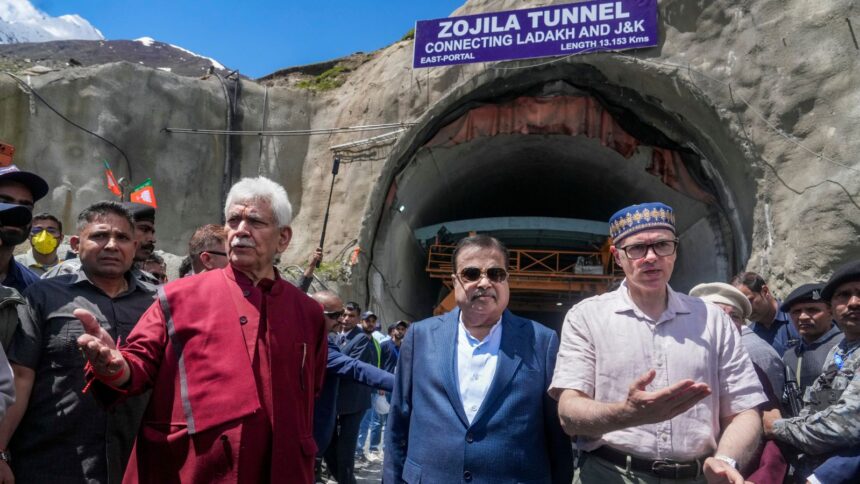
A final 2.5 metres of rock inside the was blasted away with 300 kg of explosives on Tuesday, marking a major breakthrough in the construction of the 13.153-km tunnel that will provide all-weather road connectivity between Kashmir and Ladakh.
The breakthrough was flagged off by Union Road Transport and Highways Minister , alongside Jammu and Kashmir Chief Minister Omar Abdullah and Lieutenant Governor Manoj Sinha.
Once completed, the tunnel connecting Baltal and Meenamarg will provide an alternative to the Zojila Pass, which remains closed for nearly six months every year due to heavy snowfall. The project is expected to transform connectivity for residents, tourists and security forces travelling between Kashmir and Ladakh.
At an altitude of 11,578 feet, the Zojila Tunnel is set to become the world’s longest bi-directional single-tube road tunnel at such a height. The tunnel forms the centrepiece of the 30.894-km Zojila project, which includes roads, bridges and tunnels aimed at ensuring year-round access to Ladakh.
Construction has been fraught with challenges. Engineers had to tunnel through the fragile Himalayan geology while coping with temperatures plunging to minus 30 degrees Celsius and the constant threat of avalanches. In one incident, an avalanche trapped 170 workers, all of whom were later rescued.
Work on the tunnel began in October 2020 after Gadkari launched construction. Excavation progressed simultaneously from the Baltal and Meenamarg ends using the New Austrian Tunnelling Method (NATM), under which small sections of rock are blasted, followed by immediate reinforcement with shotcrete and rock bolts.
By Tuesday, tunnelling teams working from opposite ends had reduced the remaining rock barrier to just 2.5 metres. The final blast connected the two sections deep beneath the snow-covered mountains of the Zojila range.
Despite the breakthrough, significant work remains before the tunnel can be opened. Officials said overall physical progress stands at 68.55%, with around four kilometres of final lining yet to be completed, along with emergency tunnel infrastructure and associated road works.
The tunnel is expected to be ready for military use by December 2026. While the official target for opening it to civilian traffic is February 2028, Gadkari suggested efforts are underway to advance the timeline. Engineers from project contractor Megha Engineering & Infrastructure Limited said the tunnel would require about two more years of work before it is fully operational for the public.
The ₹6,808.69-crore project is being executed by Megha Engineering & Infrastructure Limited.
“It is a good day for infrastructure in India, as this tunnel will soon become the lifeline of Kashmir, Ladakh and Leh,” Gadkari said, adding that nearly 80% of the workforce employed on the project comprises local residents.
Calling the breakthrough a long-awaited milestone, Abdullah said improved connectivity would boost transport, tourism and economic opportunities across Jammu and Kashmir and Ladakh, and expressed hope that the remaining work would be completed swiftly.

