



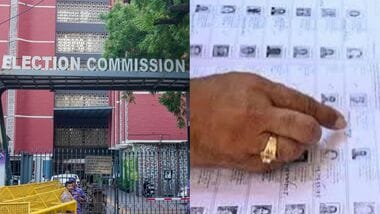
The Election Commission of India (ECI) on Friday directed chief electoral officers (CEOs) across all states and Union Territories to restrict the number of Form 7 applications an individual can submit, in an attempt to curb misuse of the form, which permits voters to challenge proposed additions to electoral rolls or seek the removal of existing entries.
According to reports, the EC’s decision stems from repeated instances in which individual electors have filed Form 7 objections in bulk on ‘unsubstantiated grounds’. According to the poll panel, this practice has caused inconvenience to genuine voters whose names were challenged while creating unnecessary administrative burdens for field-level staff.
Form 7 allows a registered voter to challenge someone’s proposed inclusion in the electoral roll or seek the removal of an existing entry. The applicant must be registered in the same constituency as the person whose entry is being challenged. -based verification was recently added to the online process.
The directive issued to all CEOs comes a week after a BJP leader in Karnataka sparked controversy by filing Form 7 applications for several hundred people. According to media reports, Ravi Patil, a BJP leader from the Belagavi North Assembly constituency, is facing charges of abusing Form 7 to seek the deletion of the names of some Muslim voters.
An FIR against Patil was registered at the Belagavi Market Police Station over allegations of misusing Form 7 and illegally deleting the names of roughly 200 Muslim voters from Veerabhadra Nagar during the Special Intensive Revision (SIR) of electoral rolls.
Under the new guidelines, an individual can file a maximum of 10 Form 7 applications during the entire claims-and-objections period. Additionally, during continuous updation, an individual can file a maximum of five Form 7 applications per month.
Separately, under Rule 17 of the Registration of Electors Rules, 1960, the Electoral Registration Officer (ERO) must reject applications that do not meet the prescribed deadline, format, or submission procedure. Each form must include complete details and the objector’s original signature; signature stamps are not permitted. EROs must also verify the applicant’s identity by checking their details against the electoral roll.
EROs must notify the objector, hear their case, and record a separate statement for each Form 7 application before deciding on an objection. If the officer finds grounds to proceed, the person whose electoral roll entry is being challenged must also be given a chance to be heard before a final order is issued.
According to ANI, Booth Level Agents (BLAs) appointed by political parties can submit up to 50 forms daily before the draft electoral roll is published during the SIR exercise, and 10 per day after publication. Individual electors, however, previously had no clearly defined numerical limit for offline submissions.
The Manual on Electoral Rolls, 2023 already prohibited bulk filings by individuals and required the ERO to personally cross-check objections when one person challenged more than five entries. However, the number of physical forms accepted was left to the ERO’s discretion, creating uncertainty for officials.
(with agency inputs)