



Cases invoking force majeure (FM) are best seen as a lagged record of macroeconomic crises. These cases follow the familiar sequence of commercial conflict: a physical disruption triggering a contractual delay, private negotiations failing as a result, and disputes that slowly mature into formal legal challenges. This “maturation period” means that the court’s docket today is often a reflection of the world’s problems from two years ago.
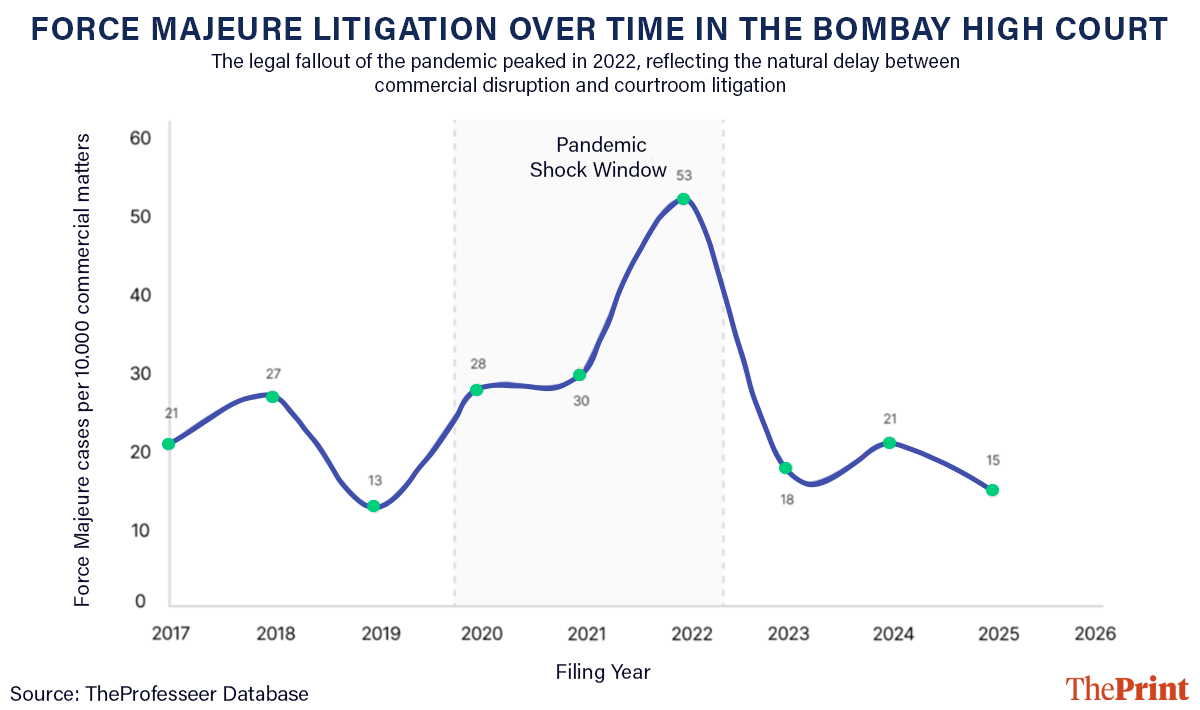
Take, for instance, the COVID-19 pandemic. The economic fallout was so significant that even the government of India issued procurement guidance treating pandemic-related disruptions as force majeure events. This trend is reflected in the data. In the Bombay High Court’s arbitration and commercial appellate dockets, FM disputes were relatively rare before 2020. However, as pandemic-era breakdowns moved from boardrooms to courtrooms, the rate rose sharply, peaking in 2022 at 53 cases per 10,000 matters. Some of these cases remain pending even today.
Across the three forums studied, the legal burden is distributed in a similar fashion across time. Roughly, a third of the cases are company matters where, for example, debtors have attempted to take the defense of the pandemic to avoid admission. Another third comprises arbitration-related challenges, where a losing party in an arbitration challenges the award against them in court because a force majeure event has not been duly considered. The remaining are a mix of applications for urgent relief – for example, injunctions, disputes regarding delays in construction, and a variety of other claims.
Force majeure originally comes from the Napoleonic Code, where it was meant specifically to cover events like natural disasters and wars. Evidence from three fora does not quite fit that original idea. “Acts of God” like these are surprisingly rare in the courtroom. Natural calamities and disruptive weather events account for less than 10 per cent of the cases we studied. Even war, which dominates current headlines and has spiked global risk indicators, historically accounts for just 6 per cent of invocations. Within that small subset, geopolitical shifts like the US withdrawal from Afghanistan and the Taliban takeover were cited in a third of the war-related pleas, while the Yemen crisis and the Russia-Ukraine war have surfaced in smaller numbers.
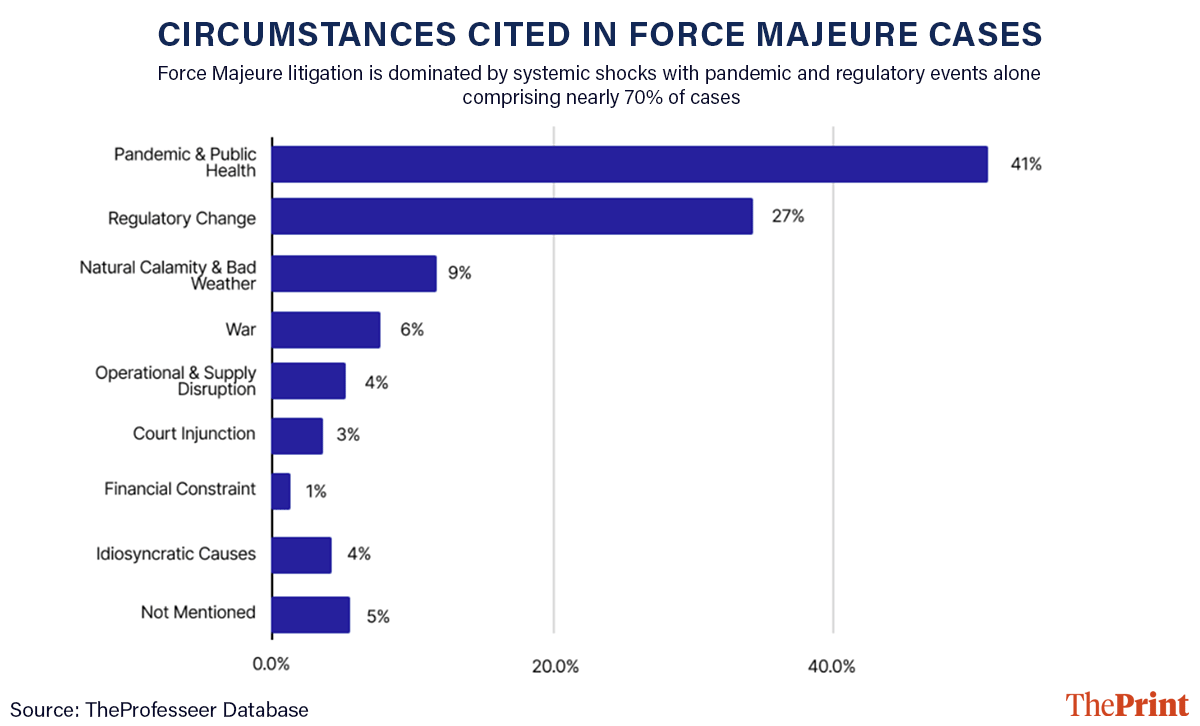
If the pandemic’s contribution to the post-2020 docket were kept aside, the second-highest cause of FM litigation is frequent regulatory and statutory change. These “Acts of State“ account for more than a fourth of all invocations. They range from municipal-level shifts, such as City and Industrial Development Corporation of Maharashtra (CIDCO) fire safety norms, to high-level interventions like the Reserve Bank of India’s oversight of foreign remittances under the Foreign Exchange Management Act (FEMA), Ministry of Electronics and Information Technology’s ban on certain mobile applications, or inconsistencies in GST implementation. Even National Green Tribunal (NGT) orders banning construction or mining activities are frequently framed as uncontrollable “superior forces” by parties looking to excuse their failure to perform. In sum, sudden state-driven interventions often pre-empt parties from performing their contracts.
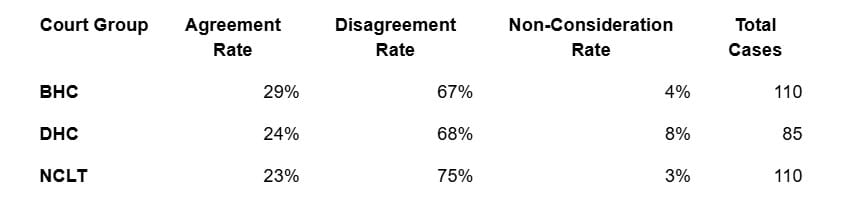
If you are banking on a force majeure plea to save your contract, the odds are heavily against you. Around 70 per cent of the time, the courts disagree with the argument. Across the three forums, the success rate hovers between 23 per cent and 29 per cent. No single forum is significantly more “sympathetic” to these pleas than the others.
The success of a plea depends heavily on the type of event invoked. In cases where the court agreed with the claim, the invoking party successfully demonstrated direct causality and a near-total impossibility of performance. For instance, in cases involving the Yemen civil war, the court noted that the situation had not improved in the five years leading up to the litigation, making the non-performance justified. This explains why “War and Security Risk” has the highest agreement rate at 68 per cent.
In contrast, while the pandemic is the most cited reason, its success rate is a low 22 per cent. This is likely because the clause is often invoked for events with only a tenuous connection to the actual lockdowns. Typically, if a COVID-related interruption is genuine, commercial parties prefer to renegotiate terms to preserve their relationship rather than litigate.
The cases that do reach the court are often the weakest links. It is surprising that, though “Acts of State” or regulatory changes fail 75 per cent of the time, it fares better than COVID as a reason in court. While the failure can be attributed to how courts are rarely convinced that a change in law was entirely unforeseeable or that it made performance truly impossible, the irony cannot be missed. Further, in the NCLT, when debtors cite GST or demonetisation as reasons for financial delay, the tribunal often clarifies that such factors are extraneous to the existence of a debt and often rejects such claims entirely.
The single most important takeaway from our study is this: Acts of the State have hijacked Acts of God. It is startling that over a fourth of all invocations are now triggered by governmental or regulatory shifts rather than natural disasters. Unpredictable policymaking poses as much of an exogenous shock to contracts as calamities like the pandemic. As an economy, “Ease of Doing Business” depends on more than just deregulation on paper; it requires a predictable legal environment where the cost of policy shifts isn’t simply dumped on the performing party.
It also follows that with a judicial rejection rate of over 70 per cent, the message from the bench is clear. If you didn’t account for the State’s volatility in your contract, the court will do little to help you. For businesses and lawyers, it is no longer enough to rely on a generic force majeure clause as a catch-all safety net. Instead, parties must bake specific regulatory and geopolitical risks directly into their pricing, credit terms, and contractual language.
As the disputes from the 2026 Gulf crisis mature and tribunals brace for a new wave of litigation, it behooves us to remember that the ‘superior force’ striking your contract is less likely to be a storm or a war. It is most possibly the stroke of a regulator’s pen.
(Edited by Ratan Priya)

