



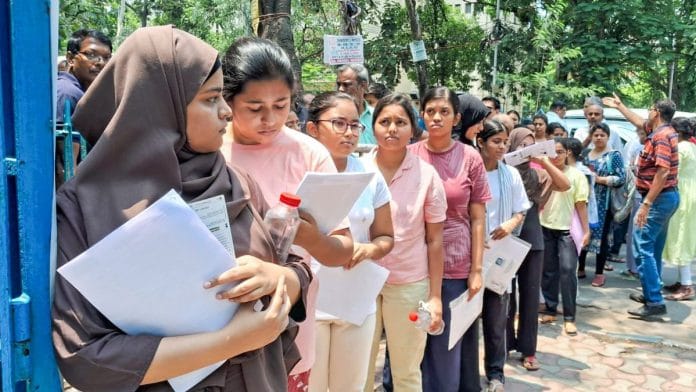
I took his claim very lightly—until I set my eyes on the actual question paper in the examination hall. My classmate had been privy to the actual question paper. Later, some of us realised that there was a small group of students in my class that had this classmate as a leader who had access to every single question paper well in advance. Not surprisingly, this group performed exceedingly well when the results were declared. It became evident to me that there were well-organised players at work. A few years later, the racket was busted when it had assumed alarming proportions.
The malady of question paper leaks has assumed a persistent, virulent form over a long period of time. However, what baffles me is not so much the leaks as the fact that we seem so helpless in our effort to stymie the rot. The remedy for this affliction does not involve rocket science. It requires good planning and a wise use of technology.
To begin with, the National Testing Agency (NTA) must put in an extraordinary effort to create a well-designed question bank that comprises a large database. It must ensure internet facilities at every examination centre. Such centres must also have reliable electrical power backup facilities and fast, robust laser printers.
The NTA must then craft an algorithm that can create, in an unpredictable fashion and in little time, a well-crafted question paper. This paper must be sent to exam centres in an encrypted form a few hours before the test begins. And each room of the examination centre must have CCTV cameras. The question paper can then be distributed without compromising the exam.
If candidates can be supplied with decent desktops or laptops, then the paper can be communicated by email to each candidate at the exact time. The answers may be typed and sent electronically to a central facility. An alternative could be candidates writing answers by hand.
This is merely a preliminary proposal. The hope is that it initiates a brainstorming programme from which a foolproof examination method can emerge that would engender faith in the examinee.
@DineshSinghEDU.
(Edited by Prasanna Bachchhav)

