



On May 2, 2025, Prime Minister Narendra Modi stood in Thiruvananthapuram, Kerala, to dedicate the Vizhinjam seaport to the nation, marking a historic milestone in India’s maritime journey. Developed by Adani Ports and Special Economic Zone Ltd (APSEZ) under a public-private partnership (PPP) at a cost of ₹8,867 crore, the Vizhinjam seaport is India’s first dedicated deep-water transshipment hub. For locals like Priya, a Thiruvananthapuram shopkeeper hoping for new jobs, and port workers like Anil, who witnessed the arrival of massive container ships, the Vizhinjam seaport is a beacon of opportunity. This blog explores the key features of the Vizhinjam seaport, its significance, challenges, and what lies ahead, celebrating a project that places Kerala on the global maritime map.
Real-Time Updates: A Historic Inauguration
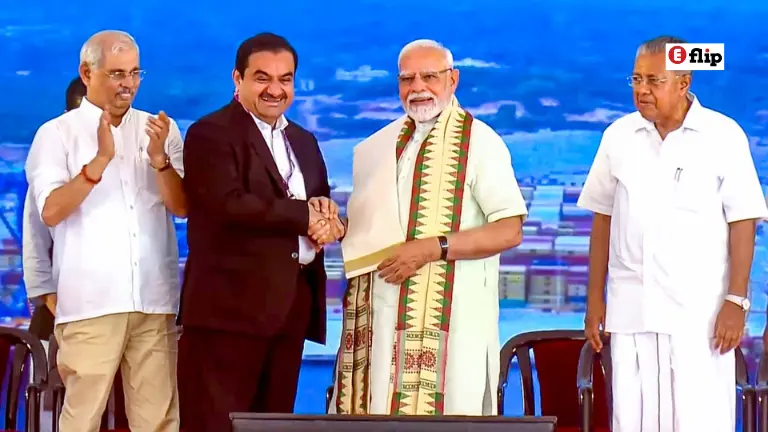
On May 2, 2025, at 11:33 a.m., PM Modi formally commissioned the Vizhinjam seaport, arriving by helicopter to inspect facilities and welcome the mothership MSC Celestino Maresca. The ceremony, attended by Kerala Governor Rajendra Arlekar, Chief Minister Pinarayi Vijayan, Union Shipping Minister Sarbananda Sonowal, and Adani Group Chairman Gautam Adani, was a moment of pride. “The Vizhinjam seaport will bring economic stability to Kerala and the nation,” Modi declared, emphasizing its role in global trade.
Since trial operations began in July 2024, the Vizhinjam seaport has handled 285 ships and processed 593,000 TEUs (Twenty-foot Equivalent Units), surpassing expectations. Its inclusion in the Mediterranean Shipping Company’s (MSC) Jade Service, connecting Singapore to Europe, underscores its global appeal. Despite security concerns following the recent Pahalgam terrorist attack and hoax bomb threats, Kerala deployed 800 police personnel to ensure a smooth event.
Key Features of the Vizhinjam Seaport
The Vizhinjam seaport, located 14 km from Thiruvananthapuram, is a technological and strategic marvel. Here are its standout features:
- Deep-Water Transshipment Hub: As India’s first dedicated transshipment port, the Vizhinjam seaport handles large container ships, transferring cargo to smaller feeder vessels for regional ports. Its 20-meter natural draft, one of India’s deepest, accommodates mega-vessels like the MSC Türkiye, which docked in April 2025 with 24,000 TEUs.
- Semi-Automated Technology: The port is India’s first semi-automated facility, featuring AI-powered systems, including a Vessel Traffic Management System (VTMS) developed with IIT Madras. Remote-controlled quay cranes and IoT-enabled processes enhance efficiency.
- Massive Capacity: Phase 1 offers a 1,800-meter container berth and 1.5 million TEUs annual capacity, with potential to scale to 4.5 million TEUs based on current trends. By 2028, Phase 2 will add a 1,200-meter berth and 3 million TEUs capacity.
- Strategic Location: Just 10 nautical miles from east-west shipping routes connecting Europe, the Persian Gulf, and Asia, the Vizhinjam seaport rivals Colombo and Dubai. Its proximity to National Highway 66 and Trivandrum International Airport (15 km) boosts connectivity.
- Engineering Feats: The port’s 2.95-km breakwater, India’s deepest at 28 meters, ensures all-weather operations. Minimal littoral drift reduces maintenance costs, unlike other Indian ports.
- Multimodal Connectivity: A cloverleaf interchange and planned railway link to the national network will handle future cargo growth. The port’s integration with NH-66 and Konkan Railway enhances logistics.
- Green Initiatives: The Vizhinjam seaport prioritizes sustainability, hosting eco-friendly ships like the MSC Türkiye and using dredged material for land reclamation in Phase 2.
For Anil, a crane operator, the Vizhinjam seaport’s automation is a source of pride. “I control machines with precision, knowing we’re competing with the world’s best,” he says.
Significance: A Game-Changer for India
The Vizhinjam seaport transforms India’s maritime landscape. Until now, 75% of India’s transshipment cargo was handled by foreign ports like Colombo, costing foreign exchange and revenue. Vizhinjam aims to recapture this traffic, saving costs and boosting efficiency. Its strategic location cuts transit times, positioning India as a trade gateway between Southeast Asia, the Middle East, and Africa.
Kerala’s economy stands to gain, with the port expected to create jobs in logistics, warehousing, and tourism. Priya, who runs a shop near Kovalam beach, hopes for a tourism boom. “More ships mean more visitors,” she says. The port’s success, handling 593,000 TEUs in months, signals its potential to rival global hubs. Chief Minister Vijayan called it “a new era in India’s maritime journey,” with two-thirds of the ₹8,867 crore funded by Kerala, showcasing state commitment.
Challenges: Navigating Obstacles
The Vizhinjam seaport faced significant hurdles:
- Local Protests: Fishermen, led by the Latin Catholic Archdiocese of Trivandrum, protested since 2022, citing sea erosion and livelihood losses. Demands for environmental studies and compensation delayed progress.
- Funding Disputes: The Centre’s ₹818 crore Viability Gap Funding (VGF) as a loan, repayable at ₹10,000–12,000 crore, drew criticism from Kerala’s Ports Minister V.N. Vasavan, who noted unequal treatment compared to Thoothukudi Port.
- Political Tensions: Opposition leader V.D. Satheesan boycotted the inauguration, citing late invitations and lack of credit to former CM Oommen Chandy, who initiated the project.
- Security Concerns: Post-Pahalgam terrorist attack, hoax bomb threats heightened security, with 800 police deployed.
- Debt Repayment: Kerala owes Adani ₹900 crore, with road connectivity incomplete, delaying full import-export operations.
For Priya, the protests hit close to home. “Fishermen are our neighbors; their fears matter,” she says, hoping for dialogue.
What’s Next: A Maritime Powerhouse
The Vizhinjam seaport is poised for growth:
- Phase 2 Expansion: By 2028, a ₹10,000 crore investment by Adani will add 77 hectares and 3 million TEUs capacity, fully funded by APSEZ.
- Additional Projects: Adani plans a cruise terminal, bunkering unit, fishing harbor, and seafood park, with investments rising to ₹20,000 crore.
- Global Integration: Inclusion in MSC’s Jade Service and visits by ships like MSC Türkiye signal growing international trust.
- Connectivity Enhancements: A railway link and cloverleaf interchange will streamline logistics, with construction starting soon.
- Community Engagement: Addressing fishermen’s concerns through compensation and environmental studies is critical for harmony.
A Human Story of Hope and Ambition
For Anil, operating cranes at the Vizhinjam seaport is a dream job, a chance to contribute to India’s rise. For Priya, it’s hope for a brighter future for her children. The port’s inauguration, amidst tight security and political debates, reflects India’s ambition to reclaim its maritime heritage, once vibrant under the Ay dynasty. As Modi said, “This will give sleepless nights to many,” signaling a challenge to global ports like Colombo.
Inspired by the Vizhinjam seaport’s launch or curious about its impact? Share your thoughts or hopes for Kerala’s maritime future in the comments. Want to stay updated? Follow our blog for the latest on India’s trade ambitions. Let’s celebrate Vizhinjam’s rise and support its journey!

