



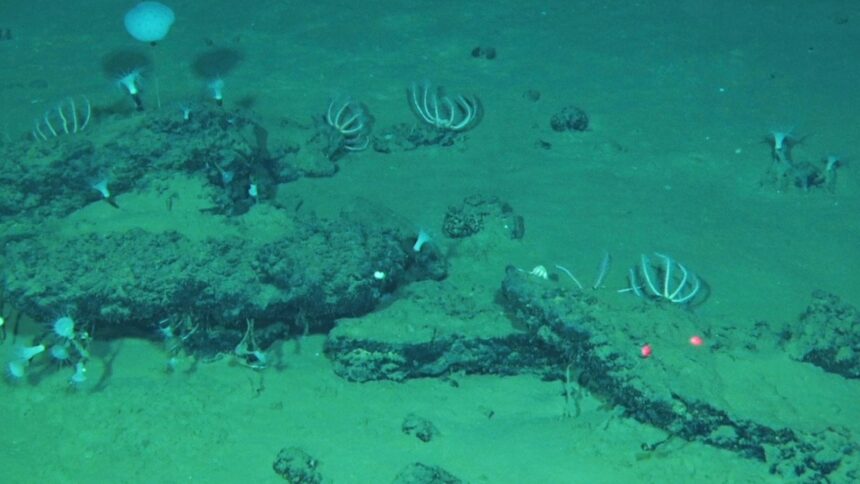
A team of Chinese deep-sea researchers has discovered what is believed to be the Earth’s deepest and most extensive known accumulation of whale fossils, carcasses and the ecosystems they support in the southeastern Indian Ocean. The findings, detailed in a study published in Nature, suggest that the site sustained deep-sea life over millions of years. The Guardian described the vast chain of habitats created by whale remains as a “whale-fall community supercorridor” stretching across the ocean floor that sustained deep-sea life over millions of years. The finding adds to a growing list of remarkable marine discoveries, including deep-sea organisms that scientists say may represent .
According to a report published by the South China Morning Post (SCMP), the discovery was made by scientists from the Chinese Academy of Sciences (CAS), in collaboration with researchers from the University of Pisa and Earth Sciences New Zealand.
The SCMP reported that the researchers identified a vast “whale-fall” ecosystem in the Diamantina Fracture Zone of the Indian Ocean. A whale fall refers to the process by which the carcass of a dead whale sinks to the ocean floor, creating a localised ecosystem that supports a variety of deep-sea organisms.
The study found that whale-fall records have historically been limited, with most previously documented examples found at depths of less than 4,000 metres. The deepest known whale fall before this discovery had been recorded at a depth of 4,204 metres.
According to Nature, The newly discovered site spans approximately 1,200 kilometres along the seafloor and lies at depths ranging from 4,200 to 7,002 metres, extending the known depth range of whale-fall ecosystems far beyond previous records.
The SCMP reported that researchers aboard the Chinese submersible Fendouzhe (also known as Striver) first identified multiple whale falls and fossils in the area between February and March 2023.
According to the report, the team subsequently conducted 32 additional dives over the following month to map the distribution of the remains and investigate associated ecosystems.
Researchers documented and collected samples from 485 whale-fossil sites, including five active whale falls, the SCMP said. The report added that scientists estimated that more than 10 million whale carcasses could potentially exist across the broader area.
Among the findings was an active whale-fall ecosystem at a depth of 6,789 metres, which the study identified as the deepest known example of its kind to date, according to the SCMP.
The SCMP reported that isotopic dating conducted by the researchers suggested that the oldest fossils discovered at the site were approximately 5.3 million years old, indicating that whale falls have occurred in the region since at least the Early Pliocene epoch.
Many of the fossils belonged to deep-diving beaked whales, including both extant and extinct species. Researchers also formally identified a previously unknown extinct species, naming it Pterocetus diamantinae, as Nature states. The finding adds a new branch to the evolutionary history of beaked whales and underscores the site’s value as a fossil archive.
Researchers suggested that the exceptional preservation of the remains may have been aided by low sedimentation rates, mineral coatings and the dense structure of beaked whale bones, allowing fossils to survive for millions of years on the seafloor, as stated by Nature.
The largest whale fall documented during the expedition consisted of the carcass of a five-metre-long Antarctic minke whale found at a depth of 5,610 metres, the SCMP reported. The species identification was made through genetic analysis and examination of the whale’s ear bones.
Scientists recorded a diverse community of organisms associated with the active whale falls, some of which the Nature study said may be new to science. Alongside worms, crustaceans and molluscs, researchers documented creatures such as brittle stars and bone-eating worms that thrive on the nutrients released by decomposing whale remains, with The Guardian highlighting these species as examples of the specialised life supported by whale-fall ecosystems.
The report stated that researchers identified 35 macrofaunal taxa, dominated by worms, crustaceans and molluscs, along with cnidarians and nematodes.
In the Nature paper, the authors wrote that the findings “reshape the understanding of the limits and biogeography of whale-fall ecosystems” and establish certain deep-sea environments as fossil archives capable of tracing whale evolution over geological timescales.
The SCMP reported that the study’s authors suggested a combination of natural mortality and the physical demands of deep diving may explain the accumulation of whale remains in the region.
According to the report, beaked whales regularly dive beyond 1,000 metres and can hold their breath for more than an hour. However, the researchers proposed that foraging below 3,000 metres may be physiologically demanding enough to increase the risk of fatal exhaustion or decompression sickness.
The study also suggested that the Diamantina Fracture Zone’s V-shaped topography may funnel sinking carcasses into a concentrated area on the seabed, contributing to the formation of the whale graveyard, the SCMP reported.
In a commentary accompanying the Nature study, Stephen J Godfrey of the Calvert Marine Museum described the site as “a truly unique discovery” and suggested that further exploration of the region could reveal even more insights into the evolution of whales and deep-sea ecosystems.

