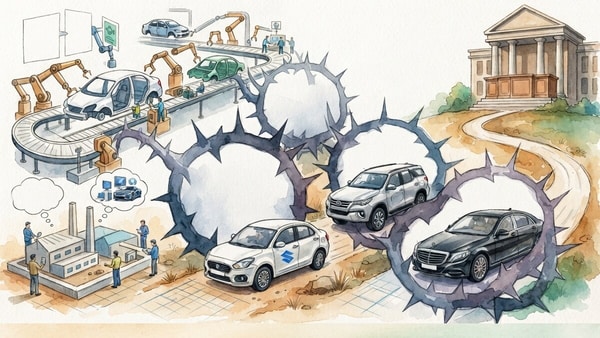
For some of the country’s biggest carmakers, preparing to launch new products and invest thousands of crores, flare-ups in tax disputes are offering little respite.
At least three foreign-owned carmakers, including Maruti Suzuki, Toyota and Mercedes-Benz, have reported sharp increases in different types of tax disputes in FY26, with some of the biggest rises in at least four years. The disputes range from goods and services tax (GST) and income tax to customs duty.
Toyota Kirloskar Motor Pvt. Ltd’s indirect-tax disputes almost doubled to ₹1,944 crore in FY26 from ₹978 crore. The claims largely involve the classification of imported parts and components, its annual filing showed.
Mercedes-Benz India Pvt. Ltd’s income-tax disputes rose 74.8% to ₹166.8 crore from ₹95.4 crore, its annual filing showed.
Maruti Suzuki India Ltd’s GST disputes rose more than sixfold to ₹128 crore in FY26, from ₹20 crore a year earlier. The country’s largest carmaker also saw income-tax demands on issues previously decided in its favour rise 25.8% to ₹11,124 crore, according to its annual report. These demands relate to matters on which appellate authorities had ruled in Maruti’s favour for earlier years, but which the tax department has raised again for subsequent assessment periods.
The increase in disputes comes as the carmakers plan fresh investments in India. Maruti has committed ₹77,500 crore towards investments in the country, while Toyota is setting up a new manufacturing plant in Maharashtra. Mercedes-Benz is also looking to widen its luxury portfolio as competition intensifies.
Disputed tax claims do not necessarily mean an immediate cash outflow. But they can make it harder for companies to plan costs and allocate capital, particularly when demands remain unresolved for years or similar claims are raised across multiple assessment periods.
Vinay Piparsania, founder at MillenStrat Advisory and Research and a former Ford India executive, said that the demands are always manageable as they often get reduced or overturned.
“When you put ₹1,000–2,000 crore into a plant, a localization programme, or a new technology, the tax rate is something you can model. What you can’t model is whether customs classification, transfer pricing, GST credits, or will be read the same way five years later,” Piparsania said.
“If an interpretation is challenged years afterwards, a decision that made sense at the time, suddenly has very different economics,” he said.
The disputes have also slowed the companies’ efforts to reduce their overall tax litigation. Maruti’s total disputes across income tax, GST, excise, service tax, customs, sales tax and local taxes stood at ₹18,183 crore in FY26, down just 2.8% from ₹18,705 crore a year earlier.
Toyota’s combined income- and indirect-tax disputes remained almost unchanged at about ₹2,200 crore. India’s total tax disputes, including income tax, excise, sales tax, service tax and GST, rose 15% to ₹593 crore from ₹515 crore.
A spokesperson for Mercedes said that the matters are taken in ordinary course of business which includes tax assessments and proceedings.
Queries sent to Maruti Suzuki and Toyota Kirloskar Motor seeking comments went answered till press time.
“Considering the merits of the matters and our experience in similar proceedings, we don’t estimate material impact on internal processes, cost planning or future investment decisions. We also acknowledge the role of the tax administration which has simplified or clarified many of the topics proactively, which actually supports the ease of doing business,” the spokesperson said.
Aditya Bhattacharya, partner at King Stubb and Kasiva, said that it is appropriate for tax regulators to investigate companies to ensure no wrongdoing, but lengthy investigation periods and high-value disputes introduce uncertainty.
“International automotive companies invest heavily, amongst other areas, in production infrastructure, together with technology, local production and supply chains. Typically, such investment is of a long-term nature. As a result, stable taxation and regulatory environments form an important part of encouraging business investment,” Bhattacharya said.
“Rather than seeking to shield businesses from proper tax investigation, it is vital that the extra, potentially unwarranted, business cost associated with extended differing evaluations of taxation issues is avoided wherever possible,” he noted.
A similar broad-based increase has not been seen across the rest of the auto industry. Companies such as PV, Hero, Bajaj, TVS, Mahindra and Hyundai have not seen sharp flare-ups in their tax disputes.
The disputes come as India prepares to welcome new luxury brands, including BMW’s Alpina and Hyundai’s Genesis, adding to the investment plans of global automakers. The companies are looking to expand their presence in a market where demand for premium vehicles is growing.
Maruti has expanded its production capacity to about 2.9 million vehicles a year, after additions at Kharkhoda in Haryana and Hansalpur in Gujarat. It is also preparing a new plant at Sanand, Gujarat, with an eventual capacity of one million vehicles a year.
at Bidkin in Maharashtra, with production expected to begin in the first half of 2029. Mercedes-Benz is widening its luxury portfolio with new models.
The issue comes at a time when Skoda Auto Volkswagen India Pvt. Ltd faces a fresh hearing before a new Bombay high court bench over a customs notice seeking ₹11,526.5 crore in differential duty, besides interest and penalties. The case is being closely watched as a landmark dispute for the industry.
The dispute concerns imported parts for its Chhatrapati Sambhajinagar plant. The Directorate of Revenue Intelligence has argued that these should be treated as completely or semi-knocked-down vehicle kits rather than individual components, which would attract higher customs duty.
An earlier bench concluded hearings in April 2025 and reserved its judgment, but released the matter without a verdict in August 2026. A new bench has since been constituted, requiring the case to be heard afresh.
Skoda has said it has a strong case and has not made a provision for the demand. It has described the notice’s calculation as overstated and unsupported by detailed computation.