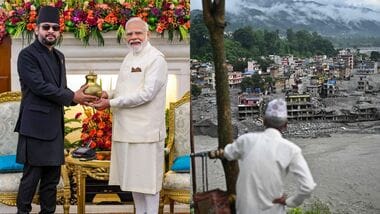
Prime Minister Narendra Modi announced Monday a $1.62 billion (24,000 crore Nepali rupee) economic assistance package to help Nepal rebuild areas devastated by deadly Himalayan floods in August this year.
In a joint press statement with Nepali Prime Minister Balendra Shah, PM Narendra Modi said, “We extend our deepest condolences for the lives lost during the recent flash floods in Nepal. India announces a 24,000 crore [ ₹240 billion] Nepali rupees development package for Nepal.”
The destroyed roads, bridges, power plants, farms and homes, causing an estimated $4.7 billion in losses, according to Nepali authorities. The UN Fund for Responding to Loss and Damage also pledged about $20 million to support Nepal’s recovery.
As many as 1,500 people were killed and more than 5,200 were missing in the aftermath of the floods.
PM Modi announced the aid after meeting in New Delhi on Monday.
Shah is on his first visit to India since taking office in March, six months after a youth-led uprising over corruption and nepotism forced former Prime Minister from power.
PM Modi said the assistance would help restore infrastructure, rebuild communities and support people who lost their homes and livelihoods.
“Our commitment will be to help affected families get their lives back on track, create new opportunities and further strengthen Nepal’s capacity to deal with future disasters,” PM Modi said.
Shah thanked India for consistently acting as a first responder for Nepal “in times of natural disasters and difficult hours”.
“I warmly welcome Indian investors to Nepal to partner in the economic prosperity of our two countries in the coming days,” Shah said, and invited PM Modi to visit the Himalayan nation.
The two countries signed agreements to boost their economic relationship.
PM Modi and Shah also virtually inaugurated a hydropower project and an oil storage facility in Nepal, as well as an oil pipeline and a cross-border train service connecting the two countries.
Nepal shares an open border with India, allowing people to cross without passports or visas. India has traditionally wielded considerable influence in the Himalayan nation, but ties have been strained by territorial disputes and accusations of political interference.
China, meanwhile, has expanded its presence in Nepal in recent years, investing in airports, highways and hydropower projects, the Associated Press reported.
Despite growing Chinese influence in Nepal, the landlocked country remains heavily dependent on India for fuel and other essential supplies. At the same time, energy ties have become increasingly reciprocal, with India importing around 1,200 MW of electricity from Nepal.
($1 = 148.6200 Nepalese rupees)
(With inputs from agencies)