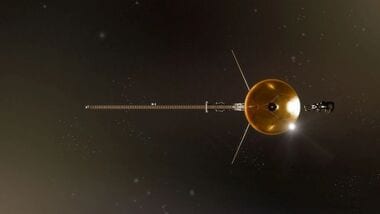
NASA’s Voyager 1 spacecraft is approaching an unprecedented milestone in space exploration, as it prepares to travel one light-day away from Earth — a distance no other human-made object has ever reached.
Launched in 1977, Voyager 1 is expected to reach the milestone on Wednesday (November 18), when it will be more than 16 billion miles (25.9 billion kilometres) from Earth. At that distance, light travelling from Earth would take 24 hours to reach the spacecraft, according to NASA.
Voyager 1 is already the most distant human-made object from Earth and has continued travelling through space for nearly five decades. Reaching the one light-day mark will add another historic achievement to its long-running mission.
A light-day is the distance light travels in 24 hours. Since light travels at approximately 186,000 miles (300,000 kilometres) per second, one light-day is equivalent to about 16.1 billion miles (25.9 billion kilometres).
For Voyager 1, reaching this distance means that any light signal travelling from Earth would take an entire day to reach the spacecraft. Similarly, a signal sent back by Voyager 1 would take approximately 24 hours to travel to Earth.
NASA launched Voyager 1 in 1977 to study the outer planets, particularly Jupiter and Saturn. Its mission was designed around a rare planetary alignment that occurs approximately once every 176 years, allowing the spacecraft to explore multiple giant planets.
Voyager 1 entered interstellar space in 2012 after crossing the heliosphere — the protective bubble of particles and magnetic fields generated by the Sun.
The spacecraft continues to collect scientific observations of the environment beyond the heliosphere, providing researchers with valuable information about interstellar space.
Its twin, Voyager 2, followed a different trajectory and entered interstellar space in 2018. The two spacecraft remain the only human-made objects to have operated beyond the heliosphere, according to NASA.
Voyager 2 is the only spacecraft to have studied all four of the solar system’s giant planets — Jupiter, Saturn, Uranus and Neptune — at close range.
During its journey, the spacecraft made several important discoveries.
At Jupiter, Voyager 2 discovered a 14th moon. It subsequently became the first human-made object to fly past Uranus, discovering 10 new moons and two rings around the planet.
Voyager 2 was also the first spacecraft to fly by Neptune, where it discovered five moons, four rings and the planet’s famous Great Dark Spot.
On December 10, 2018, Voyager 2 entered interstellar space, joining Voyager 1 beyond the heliosphere.
Despite being more than 16 billion miles from Earth, Voyager 1 continues to communicate with mission controllers through NASA’s Deep Space Network.
The network, managed by NASA’s Jet Propulsion Laboratory (JPL), enables communication with the distant spacecraft and helps scientists receive scientific observations from the probes.
NASA JPL, managed by the California Institute of Technology (Caltech) in Pasadena, built and operates the Voyager spacecraft. The mission is funded by NASA’s Heliophysics Division at the agency’s headquarters in Washington.
To mark the occasion, NASA has invited people across the world to participate in a unique light-signalling campaign called ‘Shine Bright for Voyager’s Light-Day’.
The initiative encourages people to flash golden lights towards the sky after sunset on Tuesday, November 17, creating a symbolic wave of light around the planet ahead of Voyager 1’s historic milestone.
NASA has also developed an automated online flasher that allows people to use their smartphones and tablets to send Voyager 1’s call sign, ‘V-G-R’, in Morse code.
“After sunset on Tuesday, Nov. 17, we invite you to ‘Shine Bright for Voyager’s Light-Day’ by lighting a signal skyward, joining a worldwide celebration of this historic moment, nearly 50 years in the making,” NASA said.
Participants can use the automated flasher through their mobile device’s web browser or use a flashlight, glow stick, solar lantern or bike light to flash the letters V-G-R in Morse code.
The agency has encouraged participants to capture photographs and videos of their signals and share them on social media, tagging NASA’s official account, @NASA.
NASA has outlined a simple way for people to participate in the global celebration using lights and Morse code.
The initiative requires participants to flash Voyager’s call sign, V-G-R, towards the sky after sunset on November 17.
The Morse code sequence for the three letters is:
– V: Three quick flashes followed by one long flash (dot-dot-dot-dash).
– G: Two long flashes followed by one quick flash (dash-dash-dot).
– R: One quick flash, one long flash and another quick flash (dot-dash-dot).
NASA recommends repeating the sequence for around one minute. Participants can use the automated V-G-R flasher on a smartphone or tablet or manually switch a flashlight on and off to create the signals.
The agency has also asked people to share their participation online to help create a symbolic wave of golden light around the planet.