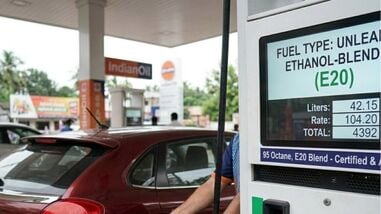
Bharat Petroleum Corporation Limited (BPCL) has faced criticism on social media after deleting a post that was intended to demonstrate compliance with India’s petrol standard. Users questioned the test image accompanying the post, alleging that it indicated an ethanol concentration of around 33% rather than the prescribed 20%.
The company had shared the post on Sunday as part of a campaign to counter claims that petrol sold at certain fuel stations contained ethanol above the prescribed limit. BPCL maintained that its testing demonstrated compliance with the E20 standard, the Millennium Post reported.
However, social media users disputed the interpretation of the test results, arguing that the measuring container shown in the photograph suggested a substantially higher ethanol concentration. The post was subsequently deleted, although screenshots continued to circulate on Monday.
Some users questioned why BPCL had removed the post instead of clarifying the disputed reading. The claim that the image showed approximately 33% ethanol, however, has not been independently verified.
The controversy comes amid a wider dispute between the Karnataka government and public sector oil marketing companies over the ethanol content of petrol sold in the state.
The Congress-led Karnataka government has alleged that fuel samples collected from several districts contained ethanol concentrations above the prescribed limit.
State Food, Civil Supplies and Consumer Affairs Minister Rizwan Arshad said laboratory tests of 63 petrol samples collected from seven districts had revealed excessive ethanol blending at several retail outlets. According to the state government’s findings, some samples contained ethanol concentrations exceeding 30%, with the highest reported reading reaching 31.2%.
The findings prompted concerns about the possible implications of higher ethanol concentrations for vehicle performance, fuel efficiency and components, particularly in vehicles not designed to operate on such blends.
The Karnataka government called for greater accountability from oil marketing companies and urged the Centre to examine the potential financial implications for motorists.
However, Indian Oil Corporation, BPCL and Hindustan Petroleum have rejected the allegations, maintaining that the state’s findings were not supported by tests conducted in accordance with prescribed technical procedures.
In a statement issued through the Ministry of Petroleum and Natural Gas on November 7, the oil marketing companies said E20 petrol supplied across the country complied with the Bureau of Indian Standards specification IS 17021.
The ministry cited results from 893 petrol samples collected from depots and retail outlets across 27 states and Union Territories. According to the statement, all samples were within the prescribed ethanol concentration range of 19% to 21%.
It added that 56 samples tested in Karnataka also met the required specifications. Their ethanol content ranged between 19% and 20%, with an average of 19.30%.
The oil marketing companies questioned the sampling procedures and testing methodology used in Karnataka’s investigation. They argued that the available laboratory certificates did not provide sufficient technical details to independently validate the reported results.
The companies sought access to the state’s sampling records, laboratory reports and testing methodology, while proposing joint testing at authorised laboratories.
The Centre maintained that ethanol blending was being monitored through established quality-control mechanisms and that any confirmed deviations would be addressed under applicable regulations.
The dispute has also acquired political significance, with Congress leader Rahul Gandhi questioning the Centre’s ethanol blending programme and raising concerns about its possible impact on vehicle owners.
Meanwhile, Kerala has initiated random inspections at petrol pumps in Thiruvananthapuram, Ernakulam, Kozhikode and Kannur to examine ethanol content in fuel. The state government has indicated that the exercise could be expanded depending on the initial findings.
Samples are being sent to government laboratories for testing, with results expected within 10 days. Authorities have warned that violations, if established, could lead to action against the petrol outlets concerned, including closure and prosecution.
India’s ethanol blending programme aims to reduce dependence on imported crude oil, support domestic agricultural production and improve energy security.
Under the E20 initiative, petrol is blended with 20% ethanol, an alcohol-based fuel produced from agricultural feedstocks. The programme is intended to reduce the country’s reliance on conventional fossil fuels.
While the Centre has defended the initiative and maintained that E20 petrol meets prescribed quality standards, questions about blending levels and vehicle compatibility have continued to attract public attention.
BPCL’s deleted social media post has added another dimension to the debate. The central issue now is whether allegations of excessive ethanol blending can be established through independently verifiable testing and whether the competing claims can be resolved through a transparent process.