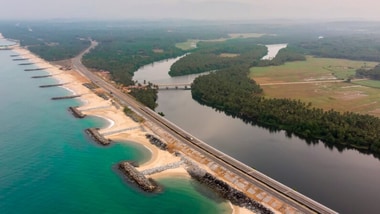
Goa and the Maldives may be ideal beach destinations on your travel list, but there’s one place in India, a stretch of coastline, that has been hiding in plain sight: coastal Karnataka.
Karnataka’s coastline is a mosaic of golden beaches, tranquil backwaters, charming fishing villages, and historic port towns. From thrilling water sports to lazy sunset strolls and temple visits by the sea, the coastal belt is where culture meets calm along the Arabian Sea, according to the Karnataka Tourism website.
It’s among the best places to slow down and unwind in the fast-paced world, offering a peaceful escape from the chaos and crowds of popular tourist hotspots.
Content creator Shrunal Waigankar, whose travels have been about “discovering places that often don’t get the attention they deserve,” has spent plenty of time exploring Uttara Kannada.
“What I love most about coastal Karnataka is the variety it offers within relatively short distances—you can go from quiet beaches and scenic coastal roads to lush forests, waterfalls, and small towns with their own distinct culture and food. I feel there’s so much potential for travellers who want to explore beyond the usual tourist circuit and experience a place at a slower, more local pace,” Waigankar was quoted by Harper Bazaar as saying.
The report states that coastal Karnataka is like a “masterclass in slowing down, a love letter to the road less taken, and an opportunity to experience firsthand the intricate ecosystem we live in that works to sustain all forms of life.”
The best part is that it still remains slightly undiscovered.
Priya Venkatesh, a naturalist and the executive director of The Naturalist School, has one suggestion. She told Harper Bazaar that those who wish to explore and understand the coexistence of a delicate ecosystem can travel between October and February, hitting the Honnavar-Kumta-Gokarana belt.
And what should you watch out for? Start with the turtles. Olive Ridley turtles nest on suitable beaches along parts of India’s coastline, and if you just happen to be God’s favourite child, you may be able to sight them, the report added.
But before you make it there, know that artificial lighting, noise, vehicles, and crowds can throw off the whole nesting process. So keep your distance, never touch turtles or hatchlings, and absolutely no flash photography.
Then there are the mangroves. “Mangroves are not simply picturesque greenery,” Venkatesh was quoted as saying. Their tangled roots shelter young fish and support coastal livelihoods. So, one must not trample the roots, litter, and they must stay on established paths, pick boat operators who follow designated routes, and leave the shells and plants where they are.
And finally, the people. “Their relationship with the coast is not a tourist attraction; it is a way of life,” Venkatesh said of the fishing communities. One must ask before they photograph anyone, respect working spaces and gear, stay clear of boats and landing sites, buy fish responsibly and, where you can, learn from those whose knowledge of the sea is generations deep.
Her one-line rule for the whole thing? “Not every beautiful thing needs to be touched, photographed, or accessed from close quarters.” Yes, even the pretty ones. Especially the pretty ones.
And how to spend your days, you may ask? Start with a surf session, move on to a meal at SOL Cafe, and close the day with a sunset over the Arabian Sea. Whether you’re an adrenaline chaser, a family on a mission or a professional lounger, you can make your itinerary work for you, the report added.
Venkatesh shared a checklist of five things one needs to find out to understand if a place/property is truly sustainable or not. Her five-point sniff test goes like this:
Look at water and energy: is consumption monitored and wastewater managed responsibly?
Check the waste story: are single-use plastics being cut, waste segregated, and disposal done properly?
Ask about local livelihoods: are locals employed, fairly paid, and involved in shaping the experience, with food and services sourced nearby?
Consider ecological sensitivity: has the property respected natural drainage, coastal vegetation, and dunes?
And demand transparency: can it say what it actually does, own up to its limits and show measurable progress, instead of hiding behind vague claims like “eco-friendly” and “close to nature”?
The real measure of sustainability, she says, “is not how much nature has been brought into a resort, but how much the resort allows nature to thrive around it.”