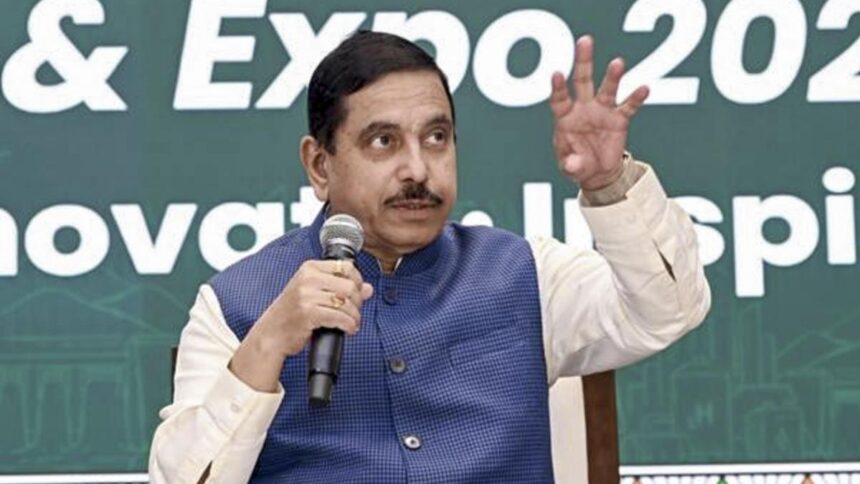
India has emerged as a major global force in clean energy with the world taking notice of its progress and growing ambitions, emphasised the Minister of New & Renewable Energy Pralhad Joshi adding that the Bharat RE Summit & Expo (BRESE) 2026 showcased the country’s push towards cost-effective RE generation, which is well suited for the Global South.
Speaking to businessline, the Minister emphasised “Summit emerged as one of India’s largest global platforms for RE. This is for the first time that three important events in the sector were held together with overwhelming participation from domestic and international stakeholders demonstrating global confidence in India’s renewable energy growth story.”
On outcomes from the summit, Joshi said that whatever India needs to do in clean energy has to be done on a large scale. For instance, India’s manufacturing capacity is rising. Solar cell manufacturing capacity will likely be 70 GW by December 2026 and may surpass 100 GW by April-May 2027.
“Once it crosses 150 GW, we should be in a position to sell them. Our solar module capacity is in excess and we need to export it. Such events help showcase India’s low cost manufacturing advantage and offer small and developing countries the cost advantage in buying our products,” he explained.
By bringing together policymakers, investors, industry, research institutions, start-ups and international development partners, this summit strengthened confidence in India’s clean energy market and helped translate national and global ambitions into a forward-looking agenda for implementation, Joshi emphasised.
“A major outcome was the strong confidence from domestic and international investors in India’s clean energy investment opportunity. To achieve 500 GW of non-fossil fuel capacity, India needs roughly $220 billion. Discussions during the summit showed that the availability of capital is not a constraint, with investors expressing positive interest in India’s long-term clean energy growth prospects, extending well beyond the immediate 2030 requirements,” he said.
More importantly, the investor participation extended beyond traditional strategic investors to include pension funds, institutional investors, and providers of long-term patient capital, reflecting the growing depth of India’s clean energy financing ecosystem, the Minister explained.
Another is the growing interest among the people on clean energy, particularly rising competence among the start-ups in the sector, the Minister pointed out.
“If you look at the summit you will find a lot of interest from schools, research and educational institutions on clean tech, which is very inspiring. It has now become a people’s movement. For instance, young boys and girls are working on green hydrogen. Similarly, a start-up has come here with a small vertical wind turbine, which it claims to generate 8 units of electricity daily. This is phenomenal and showcases how the push towards a greener future is witnessing rising participation from citizens,” he added.
For instance, youth participation and entrepreneurship were integral to the innovation agenda. The summit witnessed strong participation of more than 300 start-ups across growth and early stage in the RE Hackathon. Strong participation across youth from IITs, universities, colleges and schools was also seen in the RE GEN Challenge. The innovation ecosystem in the expo featured 70 startup pods, 40 academic posters and 10 research papers, bringing together young talent, researchers, and entrepreneurs to contribute to India’s emerging clean energy technology ecosystem, he added.
Published on November 5, 2026