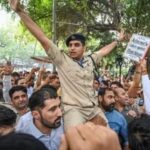
Hong Kong democracy activist Joshua Wong was sentenced to 10 more years in jail in the Chinese territory on Thursday. Human Rights Watch said on Thursday that Wong has been in custody since November 2020, when he was 23, and faces imprisonment until late 2036, when he will be 40.
Wong was potentially facing a life term as his offence was deemed to be “of a grave nature”, judge William Tam was quoted by AFP as saying.
Joshua Wong is a prominent pro-democracy activist in Hong Kong. He rose to prominence during Hong Kong’s 2014 protests, known as the Umbrella Movement, and has been in and out of jail since 2017.
He was among dozens of pro-democracy figures jailed for “subversion” in 2024, in what was Hong Kong’s largest national security trial. Some of them have since been released.
According to the Associated Press, Beijing views Wong as an anti-China figure supporting Hong Kong independence, a stance that crosses its red line.
Authorities said Wong started international lobbying as early as 2016, when he promoted a bill — he Hong Kong Human Rights and Democracy Act — that would allow the US president to impose sanctions in response to rights violations in the city.
The prosecution alleged that Wong had agreed to lobby internationally to achieve their goal of democratic self-determination. “After the security law was enacted, Law and others advanced their work abroad by meeting foreign politicians and launching petition drives,” it said.
During Hong Kong’s massive pro-democracy protests in 2019, Wong was part of a delegation to the United States to lobby for the bill, which eventually passed.
The following year, Beijing imposed the sweeping national security law on Hong Kong that effectively quashed dissent, prompting opposition groups to disband and activists to flee the city.
At the time, Wong vowed to “continue to defend my home — Hong Kong — until they silence me”.
Hong Kong authorities said the security law is crucial for the city’s stability following the 2019 protests, maintaining that the city’s law enforcement actions were evidence-based.
In September, a pro-Beijing newspaper report criticised a 2017 documentary about Wong on Netflix for “beautifying” his crimes. The city’s security bureau told local media the government was taking follow-up action.
But the documentary then shot to the top of Netflix’s popular chart in Hong Kong.
Wong was sentenced to 10 years in prison on Thursday after being convicted of conspiracy to collude with foreign forces under Beijing-imposed national security legislation.
Critics say the case highlights the continued crackdown on dissent in the city.
The 30-year-old activist was charged in 2025 under the national security law and pleaded guilty in September. The guilty plea typically allows for a reduction in sentence.
In the latest ruling, Judge William Tam said Wong’s offence was “grave” in nature and rejected arguments that his role in the alleged conspiracy was limited.
The judge said he had considered a 13-year prison term as the starting point but reduced it in view of Wong’s guilty plea.
According to AFP, the court on Thursday described Wong and fellow student leader Nathan Law — in self-imposed exile and wanted by authorities — as “two ring-leaders or masterminds” of a conspiracy to endanger national security.
Tam pointed to the US revocation of the city’s different treatment as a special administrative region and the sanctions against Chinese and Hong Kong officials, saying these were the kind of sanctions or hostile measures Wong and Law had called for.
“The punishment must fit the gravity of the crime committed,” Tam wrote, according to the Associated Press.
He added, “It is also necessary for this court to express the community’s abhorrence of the defendant’s scheme and acts together with others to collude with foreign forces…and to serve the imperative of general deterrence.”
Wong, who turned 30 last month, is already serving a four-year-and-eight-month prison sentence in connection with Hong Kong’s biggest national security case, involving an unofficial primary election organised by pro-democracy activists.
The former student leader, who had been expected to be released in January 2027 before the latest conviction, has only about two months remaining on his earlier sentence.
Hong Kong authorities used the same law to charge Wong again in June last year, accusing him of collusion with other countries and entities to impose sanctions against the finance hub and China.
The court ruled that the two sentences could run concurrently. According to reports, Tam said Wong would serve the remaining two months of the sentence for his first national security conviction concurrently with the new sentence.
Wong, who became internationally renowned during the “Umbrella Movement” that convulsed Hong Kong in 2014, has already spent almost six years behind bars and is now not due for release until late 2036.
In a statement obtained by The Associated Press, Wong wrote in prison that his political participation was never driven by hatred and he bears no resentment toward the Chinese or Hong Kong governments, adding that he never advocated Hong Kong independence.
He said he thought he was acting within the law, but only later realised his judgment was wrong.
He said during his nearly six years in prison, he enrolled in university courses and read hundreds of books.
He said he devoted himself to becoming a more responsible and compassionate person, and he hoped he’d be able to look back on this period as a trial that strengthened him.